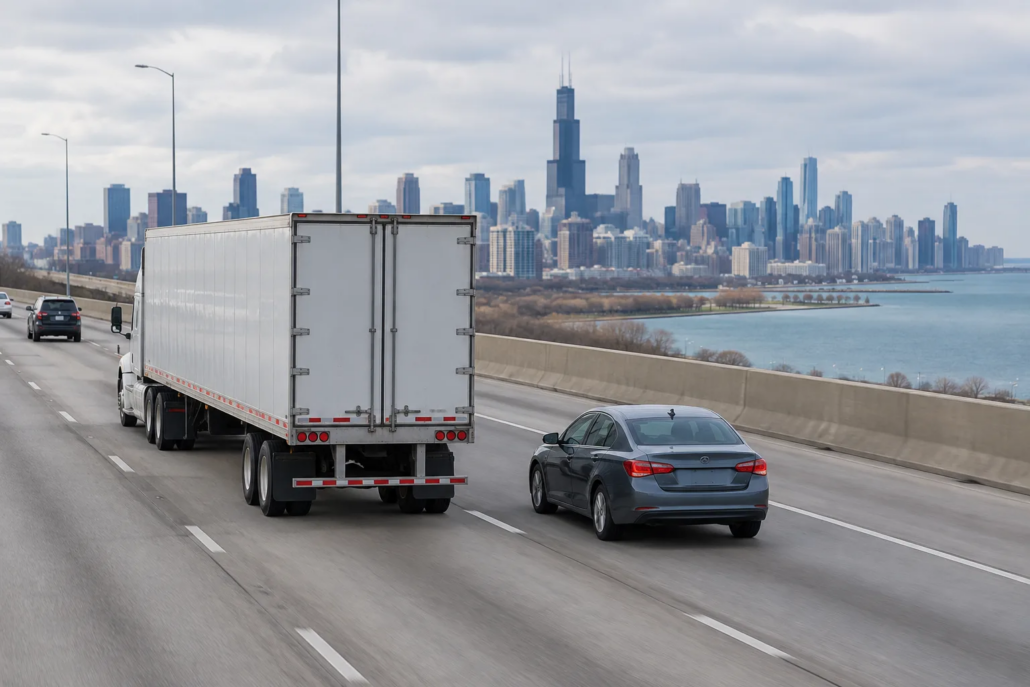
How Do Chicago Truck Lane Changes Cause Side-Swipe Crashes?
A driver moves alongside a tractor-trailer in slow Chicago traffic, then feels a sudden scrape as the truck shifts toward the next lane. A Chicago truck lane change accident can unfold in seconds, but the reason for the sideswipe may depend on where each vehicle was, what the driver could see, and when the truck began moving over. Dinizulu Law Group helps readers understand the questions that can matter without assuming that a crash’s cause is obvious from the damage alone.
This article explains how blind spots and mirror coverage can affect a lane change, what signals and vehicle positions may reveal about the sequence, and what evidence may help clarify responsibility. It also discusses why early accounts and police reports may not settle disputed details. On busy Chicago routes, including expressways and crowded urban streets, a careful look at the mechanics can offer a clearer starting point for understanding a collision.
How Can Blind Spots and Merge Timing Cause a Chicago Truck Sideswipe?
A tractor-trailer has a longer body and a different field of view than a passenger vehicle. Depending on its position, a car may be difficult for the truck driver to see beside the cab, near the trailer, or close behind it. Mirrors provide important coverage, but they do not show every angle equally well. The truck’s size, mirror adjustment, road curvature, and the relative positions of nearby vehicles can all affect what is visible.
A sideswipe may happen when several conditions overlap: a truck begins moving toward an adjacent lane, a car is already there or closing the gap, and the driver does not detect the other vehicle in time. A driver may check a mirror and see an opening, but traffic can change before the merge begins. A signal can communicate an intended move, but it does not by itself establish that the lane was clear or that the maneuver could be completed safely.
Why lane position matters
The point where the vehicles make contact can help frame questions about timing. For example, damage along the side of a car may be consistent with the vehicles moving alongside each other, but it does not independently show which vehicle crossed a lane marking first. The truck’s position, the car’s position, and whether either vehicle was changing lanes all need to be considered together.
Why Chicago traffic can complicate a merge
On Chicago, Illinois expressways and urban roads, vehicles may bunch near exits, ramps, construction, or intersections. A truck may need more space to move over, while another driver may be traveling in a truck’s blind area without realizing it. These conditions can make a short sequence difficult to reconstruct after the vehicles separate.
What Evidence Can Clarify a Truck Lane-Change Collision?
Responsibility often depends on the combined picture rather than one clue. Useful information may include the lane markings, signal use, the vehicles’ final positions, the direction and location of damage, and accounts from people who saw the merge. Video may be especially helpful if it captures the approach and the moment the truck began moving over. Depending on where the collision occurred, Chicago Police Department or Illinois State Police records may also contain initial observations or witness information.
For a closer look at how evidence from lane markings, signals, and camera footage can inform a merge-collision review, see the related discussion. Any recording’s usefulness depends on its angle, clarity, and how much of the event it captures. Nearby vehicle cameras or business video may not exist, may not show the relevant lane, or may no longer be available when someone asks for it.
Other details may help establish sequence, though none should be treated as conclusive on its own:
- Vehicle damage: Scrapes, paint transfer, and damage locations may help show where the vehicles contacted, but do not necessarily prove who moved first.
- Witness accounts: People who observed the vehicles before impact may describe lane positions or signal use. Their view and opportunity to observe matter.
- Electronic information: Depending on the truck’s equipment and what was preserved, electronic truck data that may help establish event timing could provide information such as speed or braking. It may not record lane position or whether a turn signal was used.
- Initial reports: A report can document observations made at the scene, but it may not resolve a disputed account or include every available source. Understanding the limits of a Chicago truck crash police report can help put it in context.
How Should Early Accounts of a Chicago Truck Lane-Change Crash Be Assessed?
Drivers may remember the same merge differently, especially when the event happened quickly or traffic was dense. One person may recall seeing a signal; another may remember that the truck crossed the lane line without warning. These accounts are relevant, but the circumstances of observation matter: whether a witness had an unobstructed view, how far away they were, and when they first noticed the vehicles can affect what they could reliably see.
A useful review looks for consistency among independent details. An account of the truck moving over, for example, can be compared with available video, the location of damage, lane markings, and the vehicles’ positions after impact. A signal light may be visible in a recording, but its presence alone does not answer when the signal began or whether the lane was clear. Likewise, final resting positions do not always show exactly where the first contact occurred.
In Chicago, Illinois, a crash may involve local streets, expressways, or roads near ramps where lane markings and traffic patterns change. The agency responding and the information collected can vary with the location and circumstances. In Illinois, responsibility may also depend on how the available evidence fits the applicable legal standards; the details of a particular collision matter, and laws can change. A careful review should distinguish confirmed observations from assumptions and leave unresolved questions identified rather than filling gaps with guesswork.
Frequently Asked Questions
Does a truck’s blind spot automatically make the truck driver responsible?
No. A truck’s blind spot can be relevant, but it does not automatically establish fault. A review may consider where both vehicles were, whether the truck signaled, when it began moving, and what the driver could see through available mirrors. Video, witness accounts, and damage patterns may add context. Responsibility depends on the facts and applicable Illinois law, not on the presence of a blind spot alone.
Can a turn signal prove that a truck changed lanes safely?
A signal can show that a driver indicated an intended move, if it was visible and used in time. It does not, by itself, establish that the adjacent lane was clear or that the move was made safely. A recording or witness may help clarify when the signal came on and how the vehicles were positioned. The signal is one part of the overall sequence, not a complete explanation of it.
What if the truck and car drivers give different accounts?
Conflicting accounts are one reason other evidence may matter. Available video, physical damage, witness observations, and any relevant vehicle data may help test how well each account fits the known facts. Some evidence may be incomplete or unavailable, and a report may not resolve every disagreement. An attorney can review the sources and explain how they may relate to a particular situation.
Can a sideswipe happen even if the truck driver checked a mirror?
Yes. Mirrors can provide important views but may not reveal every position around a large truck, and traffic can change between a mirror check and the start of a lane change. The mirror’s angle, the truck’s movement, and a nearby vehicle’s speed can all matter. Whether a driver’s actions met applicable duties depends on the full circumstances, not simply whether a mirror was checked.
How Dinizulu Law Group Can Help
Dinizulu Law Group is dedicated to helping people understand the facts and legal questions that may arise after a truck sideswipe. A review may consider vehicle positions, signal timing, available video, witness accounts, damage, and relevant electronic information without treating any one clue as decisive. The firm is committed to fighting for clients’ rights and can evaluate how Illinois law may apply to the circumstances. Contact Dinizulu Law Group to request a free consultation or case evaluation and discuss your situation.
The information in this article is for educational purposes only and does not constitute legal advice. Contact a qualified attorney authorized to practice in the jurisdiction that applies to your matter for advice specific to your situation.


Leave a Reply
Want to join the discussion?Feel free to contribute!