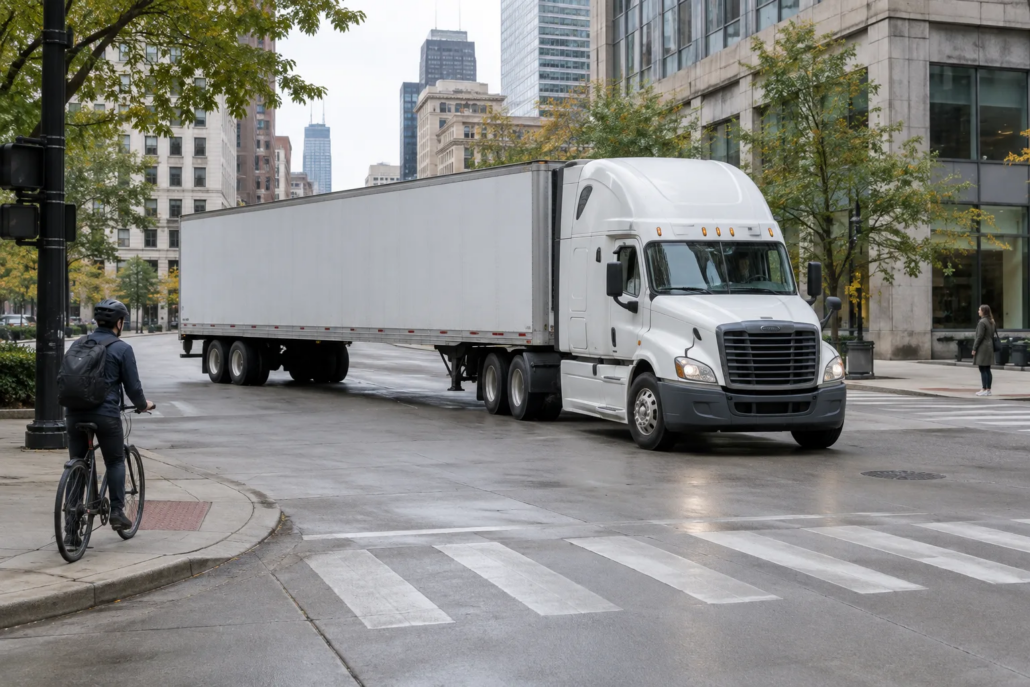
Why Are Chicago Truck Right Turns Risky for Pedestrians?
A Chicago truck right-turn pedestrian accident can begin in the few seconds when a person enters a crosswalk or rides alongside a turning vehicle. A large truck may need more room to turn than a passenger car, and its cab and trailer may not follow the same path. At the same time, mirrors and vehicle structure can limit what a driver sees beside the truck. Those factors matter, but they do not by themselves establish who was at fault.
Dinizulu Law Group helps Chicago residents understand the questions that can arise after a serious truck collision. This article explains how turning mechanics, crossing conditions, potential witnesses, and available evidence may shape an investigation involving a pedestrian or cyclist.
How a Chicago truck right turn can create a pedestrian or cyclist collision
A truck’s size affects the space it needs to turn. Depending on the intersection, a driver may position the cab farther from the curb before turning. The trailer can then track closer to the corner or cut inside the cab’s path, a movement often called off-tracking. A cyclist traveling beside the truck or a pedestrian near the curb may be in a place the driver cannot readily see.
The cab’s mirrors provide useful views, but they do not eliminate every blind area. A driver’s sightline can also change as the vehicle moves, the trailer pivots, or other vehicles and street features block the view. A person may be visible at one moment and obscured at another. Establishing the sequence therefore requires more than noting that a truck was turning.
The cab, trailer, and turning space
The truck’s route through the intersection may help explain where the vehicle and the person were in relation to each other. Investigators may compare the cab’s path, the trailer’s path, roadway marks, vehicle damage, and available video. This evidence of a truck’s wide turning path and trailer off-tracking can help clarify whether the trailer tracked inside the cab’s turn or moved into a crossing area.
Side visibility and timing
A cyclist may approach from behind or alongside a truck, while a pedestrian may enter the crosswalk as the vehicle begins to turn. The timing of signals, the truck’s speed and position, and each person’s direction of travel can all matter. These are questions to investigate, not assumptions about what any driver or road user could see.
How crossing conditions and traffic controls affect liability
A right-turn collision needs to be evaluated in the context of the particular intersection. Investigators may look at whether a pedestrian was in a marked crosswalk, whether a cyclist was traveling through the intersection or alongside traffic, and what the traffic signals or turn controls indicated. They may also consider whether a vehicle blocked a sightline or whether the truck had begun its turn before the person entered the crossing area.
Illinois traffic requirements and the facts of a specific crossing can affect the analysis. A signal indication, sign, or marked crossing may be relevant, but the presence of one detail does not automatically resolve fault. The driver’s actions, the road user’s movements, visibility, and the timing of the events may all need to be considered together. How evidence can shape fault in a Chicago truck-pedestrian collision depends on the full circumstances, not a single assumption about right-of-way.
In Chicago, an investigation may also examine the intersection’s layout: curb extensions, parked vehicles, construction, loading activity, lane markings, and the distance between the crossing and the corner. Photos or video from nearby businesses, residences, or vehicles may show conditions that changed after the collision. If a claim proceeds in court, the Circuit Court of Cook County may be relevant, depending on venue and other procedural rules. Those rules can vary and may change.
What evidence may establish the sequence of events?
The central task is often to piece together where the truck and the pedestrian or cyclist were, and when. Useful evidence may include:
- Names and contact details for witnesses who saw the approach, turn, or crossing.
- Photos of the intersection, vehicle positions, damage, roadway marks, and sight obstructions.
- Available video from traffic cameras, nearby properties, vehicle cameras, or dashcams.
- Truck records that may exist, such as GPS or telematics data, dispatch information, and inspection or maintenance records.
- Signal timing or intersection information, when available and relevant.
No single source necessarily tells the whole story. For example, a video may show the truck entering a turn but not clearly capture the crosswalk. A witness may recall a signal color but not the trailer’s exact position. Physical marks and vehicle damage can add context, but their meaning may require careful interpretation.
A police report can be a useful starting point, but it may not include every witness or movement. Comparing it with photos, video, witness accounts, and the scene can help identify unanswered questions. This includes reviewing a Chicago truck crash police report for missing or inaccurate details. Records that may be stored electronically can also have retention limits, so their availability may depend on how soon they are identified and preserved.
Examining the driver and trucking company’s conduct
An investigation may consider the driver’s actions as well as relevant company practices and records. Depending on the facts, that could include training, route or dispatch information, and whether applicable safety requirements were followed. A potential breach alone does not automatically prove liability; investigators must assess whether it relates to the collision and any resulting injury. This is the context for considering how a truck safety-rule violation may relate to an injury claim.
Frequently Asked Questions
Does a truck’s wide turn automatically mean the driver was at fault?
No. A wide turn or trailer off-tracking may be important evidence, but it does not decide liability on its own. Investigators generally examine the truck’s position and movement, crossing conditions, traffic controls, visibility, and the pedestrian’s or cyclist’s actions. The available evidence and applicable Illinois law can affect how responsibility is evaluated in a particular situation.
Can a cyclist be hit even when riding beside a truck?
Yes, a cyclist traveling near a truck may be within an area that is difficult for the driver to see, especially as the truck turns. The exact location and timing matter, as do the truck’s movement, the cyclist’s route, and the intersection controls. Those facts need to be examined together rather than inferred from the collision alone.
What if there were no witnesses to the collision?
A lack of eyewitnesses does not necessarily mean there is no useful evidence. Investigators may look for nearby camera footage, photographs, vehicle damage, roadway marks, electronic truck records, or signal information. Some evidence may not be available or may not answer every question. The value of each source depends on what it captures and how it fits with other information.
Could a trucking company be involved in a right-turn collision claim?
Depending on the facts, a claim investigation may examine more than the driver’s conduct. Relevant questions could include the driver’s work-related activity, company procedures, training, or records connected to the trip. Whether another party may bear legal responsibility depends on the evidence and applicable law. An attorney can assess which parties and issues may be relevant to a specific situation.
How Dinizulu Law Group Can Help
Dinizulu Law Group is dedicated to helping injured pedestrians and cyclists understand the issues that may arise after a truck collision in Chicago. The firm can evaluate the turning path, crossing conditions, witness information, and records that may help clarify how the event unfolded. The investigation and potential claims depend on the specific facts, and no result can be promised. If you have questions after a truck collision, contact Dinizulu Law Group to request a free consultation or case evaluation and discuss your circumstances.
The information in this article is for educational purposes only and does not constitute legal advice. Contact a qualified attorney licensed in Illinois for advice specific to your situation; laws vary by location and may change.


Leave a Reply
Want to join the discussion?Feel free to contribute!