When Is a Chicago Truck U-Turn Accident Lawyer Needed?
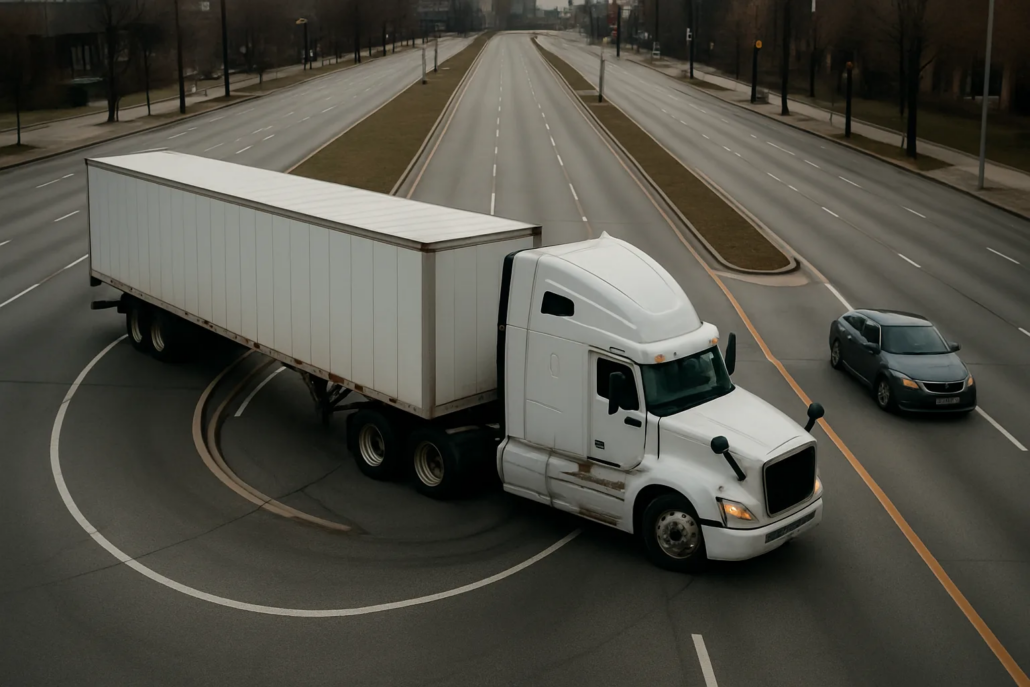
A large commercial truck begins turning across a Chicago roadway. Its trailer swings through adjacent lanes, the cab blocks another driver’s view, or the truck crosses a median opening without enough time or space. A collision can happen before anyone understands the truck’s intended path. If you are searching for a Chicago truck U-turn accident lawyer, the first questions often involve where each vehicle was positioned, whether the truck signaled, and what traffic controls applied.
An unsafe U-turn may be difficult to evaluate from the final resting positions alone. Dinizulu Law Group can help injured drivers understand which facts may matter and what evidence could clarify the sequence. This guide discusses commercial-truck U-turns, median crossings, signals, dashcam footage, vehicle damage, and witness accounts, along with general issues that may affect an Illinois injury claim.
How an Unsafe U-Turn Can Create a Chicago Truck Collision
A truck’s turning path is often wider and longer than a passenger vehicle’s. During a U-turn or turnaround maneuver, the cab may enter one lane while the trailer tracks through another. The truck may also need to cross a median, pause partway through the movement, or move across multiple lanes before aligning with the opposite direction of travel.
In Chicago, Illinois, these movements can create conflicts with vehicles traveling straight, approaching from behind, or entering from a side street. A turn may be restricted by a sign, pavement marking, traffic signal, roadway design, or local traffic rule. Even where a U-turn is not expressly prohibited, the driver generally must account for surrounding traffic and make the movement only when it can be completed safely.
Why lane position matters
Photos and witness descriptions should distinguish the truck’s cab from its trailer. Important details may include:
- Whether the truck began from the far-left lane or another position;
- Whether the trailer crossed into a neighboring or opposing lane;
- Whether the other vehicle was passing, proceeding straight, or entering an intersection;
- Whether the truck stopped, backed up, or changed its path during the turn; and
- Whether a median, parked vehicle, construction feature, or weather condition limited visibility.
A Chicago truck U-turn accident lawyer may use these facts to compare the vehicles’ paths rather than relying only on the point of impact.
What Evidence May Clarify a Commercial Truck Turning Accident in Chicago?
Evidence can disappear quickly. Vehicles may be repaired, surveillance footage may be overwritten, and witnesses may remember a complex maneuver differently over time. Generally speaking, preserving information helps an attorney assess whether the driver, carrier, another motorist, a roadway condition, or multiple factors may have contributed.
Potentially useful evidence includes:
- Dashcam and phone video. Footage may show the truck’s signal, speed, lane position, turn radius, and whether traffic had a green or red signal. Keep the original file when possible and avoid editing it.
- Photographs and vehicle damage. Images of the roadway, median opening, lane markings, debris, sight lines, and both vehicles may help explain the angle and sequence of contact. Damage patterns are clues, not automatic proof of fault.
- Witness accounts. Names and contact information can be important, especially when a witness saw the truck before impact. A witness who observed the full maneuver may provide different information from someone who heard the collision but did not see it.
- Traffic and business-camera footage. Cameras near intersections, loading areas, gas stations, or buildings may capture a truck median U-turn crash from a wider angle.
- Truck and carrier records. Depending on the circumstances, an investigation may consider inspection records, dispatch information, onboard data, driver communications, or policies concerning routes and maneuvers.
The Chicago Police Department may create a crash report when officers respond, but a report is only one part of the evidence. It may not resolve every question about signal use, visibility, or the truck’s full turning path.
Illinois Truck Maneuvering Accident Liability: Questions and Common Mistakes
Liability in an Illinois truck maneuvering accident depends on the facts. A driver may be evaluated for failing to signal, turning from an unsuitable lane, disregarding a traffic control, entering another vehicle’s path, or continuing despite an obstructed view. A motor carrier or another party may also become relevant if evidence suggests a work-related policy, maintenance issue, loading problem, or other contributing conduct.
Illinois generally uses a comparative-fault approach in personal injury cases. That means the conduct of more than one person may be considered, and an injured person’s potential recovery can be affected by the allocation of fault. The precise rules and deadlines depend on the claim and circumstances, and Illinois law may change.
Common mistakes after a truck U-turn crash include:
- Assuming the driver’s explanation settles what happened;
- Failing to photograph lane markings or the median before the scene changes;
- Posting detailed conclusions about fault on social media;
- Giving a recorded statement without understanding what information is being requested; and
- Waiting to investigate because the visible vehicle damage appears minor.
After receiving medical attention as appropriate, people often benefit from keeping collision-related records, identifying witnesses, and preserving original photos or video. An attorney may also examine whether additional evidence should be requested from a carrier, insurer, camera operator, or public agency. A lawyer can explain options based on the specific facts rather than assuming that the truck or the passenger vehicle is automatically responsible.
Frequently Asked Questions
Can a truck make a U-turn anywhere in Chicago?
Not necessarily. Whether a U-turn is permitted can depend on signs, pavement markings, intersection design, traffic controls, and applicable Illinois or Chicago rules. Even a permitted maneuver must be made with appropriate attention to surrounding traffic and available space. The absence of a prohibition sign does not by itself establish that a particular truck movement was safe or lawful.
Does a truck’s turn signal prove the driver was not at fault?
No. A signal may be relevant, but it does not answer every safety question. Investigators may also consider when the signal was activated, whether it was visible, the truck’s lane position, speed, clearance, and whether the maneuver crossed another vehicle’s path. A signal can communicate intent without making an otherwise unsafe movement reasonable.
What if I cannot identify the trucking company after the crash?
You may still have useful sources of information, such as photographs, witness accounts, dashcam footage, responding-officer records, or nearby camera systems. The truck’s appearance, trailer configuration, location, and direction of travel may help an investigation. Avoid guessing publicly about the company or driver. Depending on the facts, an attorney may explain lawful ways to identify potentially responsible parties.
Can vehicle damage show how the U-turn collision happened?
Damage can provide helpful clues about the direction and angle of contact, but it usually should be considered with scene photographs, vehicle positions, witness accounts, and available video. Repairs can alter or remove evidence, so documenting the vehicles and roadway promptly may be important. An attorney or qualified reconstruction professional may evaluate the available information in context.
How Dinizulu Law Group Can Help
Dinizulu Law Group is dedicated to helping people understand their options after truck and auto collisions in Chicago, Illinois. The firm is committed to fighting for clients’ rights while examining practical details such as lane positions, traffic controls, signal use, vehicle damage, dashcam footage, witness accounts, and potentially relevant trucking records.
The team is ready to evaluate your situation and discuss possible next steps in a consultation. Contact Dinizulu Law Group for a free case evaluation and to learn how a Chicago truck U-turn accident lawyer may be able to help assess your claim.
The information in this article is for educational purposes only and does not constitute legal advice. Contact a qualified attorney licensed in Chicago, Illinois for advice specific to your situation.


Leave a Reply
Want to join the discussion?Feel free to contribute!