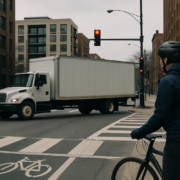
Can Chicago Truck Turns Create Liability for Cyclists?
A truck turning right at a Chicago intersection may appear to be moving slowly, but the maneuver can place cyclists, pedestrians, and motorcyclists in a dangerous path. A trailer may track across a bike lane or crosswalk, while the cab’s mirrors do not show every area beside the vehicle. If you are searching for a Chicago truck right turn bicycle accident lawyer, understanding how liability is evaluated can help you recognize what evidence matters.
Dinizulu Law Group provides information about who may be responsible for a Chicago truck accident and the issues that can arise after a collision. This article explains right-hook crashes, crosswalk conflicts, signal timing, visibility, intersection layout, injury documentation, and the questions an attorney may examine in an Illinois claim.
When Can a Right-Turning Truck Be Liable for a Chicago Cyclist or Pedestrian Injury?
A right turn does not automatically make the truck driver liable. Generally, liability depends on whether the driver or another responsible party failed to use reasonable care and whether that failure contributed to the injury. Relevant questions may include whether the driver checked mirrors, signaled, yielded, maintained a proper lookout, and completed the turn only when it was reasonably safe.
In Chicago, Illinois, the analysis may also involve the driver’s lane position, the truck’s speed, the timing of traffic signals, and whether a cyclist or pedestrian was lawfully proceeding through the intersection. Illinois fault rules can also require an assessment of each person’s conduct rather than assuming that one road user is automatically responsible.
How trailer off-tracking changes the turning path
Large trucks do not follow the same path as their front wheels. During a right turn, the trailer or rear portion may move closer to the curb, cross into a bicycle lane, or sweep across part of a crosswalk. A truck can also need additional space to complete a turn, but the need for space does not eliminate the driver’s obligation to observe traffic and yield when required.
Why mirrors and blind zones matter
A driver may see part of a cyclist’s position without seeing the cyclist’s full path. Passenger-side blind zones, mirror limitations, glare, parked vehicles, construction equipment, and other traffic can affect visibility. Information about Chicago truck blind spots and mirror visibility may help explain why a careful review of the cab, trailer, and roadway is important.
What Intersection Evidence Matters in a Right-Hook Truck Accident in Chicago?
The intersection itself often provides important context. A lawyer reviewing a right-hook truck accident in Chicago may examine whether the roadway had a marked bike lane, a shared lane, a bicycle box, a separate pedestrian signal, or a turn phase that changed how vehicles and vulnerable road users moved through the area.
Evidence may include:
- Traffic-signal timing and the sequence of vehicle, pedestrian, and bicycle indications.
- The truck’s approach lane, turn path, speed, and final position.
- Whether the driver used a turn signal and whether the signal was visible to others.
- Nearby traffic-camera footage, surveillance video, dash-camera recordings, and witness accounts.
- Photographs showing the crosswalk, curb, lane markings, sight lines, obstructions, and vehicle damage.
- Electronic records that may show braking, speed, movement, route information, or timing.
A local example can illustrate why details matter without deciding fault in another case. A Chicago bicyclist collision in Avondale highlights the importance of examining the intersection layout, the road user’s position, witness information, and the nature of the injuries rather than relying on a brief description of the crash.
Chicago transportation conditions can change quickly around construction areas, delivery zones, parked vehicles, and busy commercial corridors. A pedestrian in a crosswalk, a cyclist traveling beside the curb, and a motorcyclist approaching from behind may each have different visibility and positioning issues. For practical guidance about safe road positioning around semi-trucks, readers should consider how vehicle size and turning space affect what each road user can see.
What Should an Injured Cyclist or Pedestrian Document After a Truck Turn Collision?
After a collision, an injured person may be focused on immediate medical needs rather than evidence. Depending on the circumstances, prompt medical evaluation can help identify injuries and create a record of symptoms. People should avoid guessing about fault at the scene, because the complete picture may depend on signal records, video, vehicle data, and witness statements.
Dinizulu Law Group’s resource on what to do after a truck collision in Illinois discusses practical documentation issues. Depending on the circumstances, useful information may include:
- The responding agency’s report or incident information.
- Photographs of the intersection, bicycle or motorcycle damage, clothing, visible injuries, lane markings, and sight obstructions.
- Names and contact information for witnesses, when available.
- Medical records, follow-up visits, diagnostic testing, prescriptions, rehabilitation records, and work restrictions.
- Insurance communications and any written or recorded statements.
Preserving truck and roadway evidence
Some evidence may not remain available indefinitely. An attorney may consider requesting preservation of traffic-camera footage, nearby business video, dash-camera files, dispatch records, GPS information, telematics, and event-data-recorder information. Truck black-box data in an injury claim may help compare speed, braking, vehicle movement, or timing with witness accounts and physical evidence.
Documenting injuries and losses
A cyclist, pedestrian, or motorcyclist may experience symptoms that affect mobility, work, sleep, or daily activities. No article can determine the seriousness of an individual’s condition, and medical decisions belong with qualified providers. Keeping consistent records of appointments, restrictions, symptoms, and expenses can help an attorney evaluate common injuries caused by truck collisions and the available evidence.
Potential losses can vary widely. Depending on the facts, an evaluation may consider medical expenses, lost income, property damage, pain, disability, and future care needs. How truck accident injuries affect claim value explains why documentation, prognosis, and proof of responsibility can all influence the assessment of a claim.
Frequently Asked Questions
Is a truck driver automatically liable when a cyclist is hit during a right turn?
No. A right-turn collision does not automatically establish liability. The analysis may involve the driver’s lookout, speed, signal use, yielding, lane position, and the timing of the cyclist’s or pedestrian’s movement. Vehicle-camera footage, witnesses, roadway markings, and signal records may also matter. Illinois comparative-fault principles can make the conduct of all involved parties relevant, so a case-specific review is important.
Can a truck company be responsible for a Chicago pedestrian collision?
Possibly, depending on the facts and the relationship between the driver and company. The driver, trucking company, vehicle owner, maintenance provider, or another party may be relevant to an investigation. Employment arrangements, company policies, vehicle maintenance, and the circumstances of the trip can affect the analysis. Responsibility is not determined solely because the truck displayed a company name or was making a delivery.
What if the truck driver says the cyclist was in a blind spot?
A blind spot may be relevant evidence, but it does not by itself resolve the claim. A review may examine whether the driver used available mirrors, checked the roadway more than once, signaled, positioned the truck appropriately, and proceeded only when the turn was reasonably safe. The cyclist’s position, roadway design, signal phase, and other surrounding facts may also be considered.
Can a pedestrian recover damages after a truck crosswalk collision?
A pedestrian may have a claim if evidence supports another party’s legal responsibility and the collision caused compensable harm. Potential damages depend on the injury evidence, medical treatment, lost income, daily limitations, property loss, and other facts. Deadlines and procedural requirements can apply under Illinois law and may vary with the circumstances, so prompt advice from a licensed attorney can be important.
How Dinizulu Law Group Can Help
Dinizulu Law Group is dedicated to helping Chicago cyclists, pedestrians, motorcyclists, and other injured road users understand the evidence involved in truck-turn collisions. The firm can review the intersection layout, vehicle movement, signal timing, visibility issues, medical records, and potentially responsible parties. Its team is committed to fighting for clients’ rights while explaining the legal process in clear terms and evaluating the available documentation.
If you or a family member was injured in a truck right-turn collision, contact Dinizulu Law Group for a free consultation or case evaluation. An attorney can discuss your circumstances and help you explore your legal options.
The information in this article is for educational purposes only and does not constitute legal advice. Contact a qualified attorney licensed in Chicago, Illinois for advice specific to your situation.


