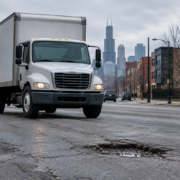
Which Scene Clues Inform Chicago Truck Road-Defect Claims?
A truck crash can happen on an otherwise ordinary trip when a pothole, uneven pavement, damaged road surface, or debris affects how a vehicle moves. If you are wondering whether a roadway defect contributed to a truck accident in Chicago, the condition is only one part of the picture. Investigators may also examine the driver’s response, the carrier’s practices, and who was responsible for maintaining the road.
Dinizulu Law Group helps people understand the evidence that may matter in a truck injury claim. This article explains what roadway hazards can do, how to document a suspected defect safely, and how road conditions may factor into a broader liability review.
How a roadway defect may contribute to a Chicago truck crash
A road defect can create a sudden change in a truck’s path or stability. A deep pothole or abrupt pavement edge may jar a vehicle, affect tire contact, or prompt a driver to brake or steer quickly. Loose debris can also lead to an evasive maneuver. A truck’s size, load, speed, and stopping distance may affect how it responds, but the result depends on the specific vehicle and circumstances.
A hazard does not prove that it caused a collision. Investigators need to consider where it was, whether the truck encountered it, and whether the timing and physical evidence fit the account of the crash. They may compare photographs, vehicle damage, roadway measurements, witness observations, and available video or inspection records.
Conditions worth noting
Examples include potholes, broken or sunken pavement, uneven seams, damaged shoulders, loose material, and objects in a travel lane. Note the condition without assuming who created it or how long it existed. A roadway issue may have multiple possible causes, and the responsible party cannot be determined from appearance alone.
In Chicago, Illinois, the road’s location can help identify which agency or entity may have maintenance information. City streets, state routes, and other roads may be overseen by different authorities. Road ownership and maintenance responsibility should be verified rather than guessed.
Documenting a suspected road hazard after a truck crash
Safety comes first. Do not enter traffic or put yourself at risk to get a photograph. If it is safe to do so, useful observations can preserve details that may change when a road is repaired, debris is moved, or vehicles leave the scene. For broader guidance, see these steps to take after a truck accident.
Record the scene and location
If you can safely document the area, consider capturing:
- Wide views showing the road layout, lanes, nearby intersections, and where the truck came to rest.
- Closer views of the suspected defect from more than one angle, with an object for scale only if it can be placed safely.
- The direction of travel, lane, approximate position, and nearby landmarks. Record the street names or intersection in your notes rather than relying on memory.
- Weather, lighting, and visibility conditions, along with the date and approximate time of your observations.
Keep original images when possible and note who took them. Do not alter a photograph in a way that changes what it shows. A short written account of what you observed can help distinguish firsthand details from information learned later.
Preserve witness accounts and the truck’s response
If witnesses are willing, note their names and contact information and ask what they personally saw. Their accounts may help clarify whether the truck struck the defect, swerved, braked, changed lanes, or reacted in another way. Avoid coaching anyone or presenting a guess as a fact.
The truck’s response matters alongside the road condition. Record what you observed about its movement, but leave conclusions about speed, braking, or mechanical issues to an evidence-based review. The official report may not include every roadway detail. Comparing it with photographs, witness information, and the location can help identify omissions or differences; this overview explains how a Chicago truck accident police report can omit or misstate facts.
How road conditions fit into truck accident liability
A roadway defect does not automatically make a city, road authority, driver, or trucking company liable. A claim generally requires evidence connecting the condition and the relevant conduct to the collision and resulting injury. Investigators may consider whether a driver had a reasonable opportunity to notice and respond to the hazard, whether the truck’s actions contributed, and whether carrier practices are relevant.
They may also determine who controlled or maintained the road. Depending on the location, records could come from the City of Chicago, the Illinois Department of Transportation, or another agency or owner. Maintenance logs, prior complaints, inspection records, repair work orders, and construction information may help explain what was known or done. Their availability and significance depend on the particular roadway and circumstances.
Claims involving public bodies can raise additional legal questions, including rules about immunity, notice, and deadlines. Those rules are jurisdiction-specific and can change, so an Illinois attorney can assess how they may apply. Illinois law also recognizes that responsibility may be shared; the effect of each party’s conduct depends on the evidence and applicable law.
A complete review may consider the driver, carrier, road authority, vehicle condition, and other circumstances together. For a broader explanation of how responsibility for a truck accident may extend beyond the driver, see Dinizulu Law Group’s guide. No single photograph or observation necessarily answers who is responsible.
Frequently Asked Questions
Can a pothole alone prove that a road defect caused a truck crash?
No. A pothole photograph may help show a condition, but it does not by itself establish that the truck encountered it or that it caused the collision. Investigators may examine the location, vehicle damage, timing, witness accounts, and the truck’s movement. They may also consider other possible causes and whether a driver or another party could have responded differently.
How can I identify who maintains the road where the crash happened?
The road’s exact location and classification can help identify the responsible authority or owner. A Chicago street, state route, or privately maintained road may involve different entities. Nearby landmarks and the precise direction of travel can help clarify the location. In many cases, maintenance responsibility needs to be confirmed through agency or ownership records rather than inferred from the street name.
What if the police report does not mention the damaged pavement?
A report may not capture every detail, so a missing reference does not necessarily resolve whether a hazard mattered. Photographs, witness accounts, location information, and other available records may provide additional context. A careful comparison can also help distinguish firsthand observations from later assumptions. The importance of any omission depends on the full evidence and the circumstances of the crash.
Could a truck driver share responsibility when a road defect is involved?
Possibly. A hazard may be part of the explanation while a driver’s speed, following distance, attention, or response is also examined. The carrier’s conduct or road maintenance may be relevant as well. Illinois rules can affect how fault is allocated and what it means for a claim, so the result depends on the facts and applicable law rather than the road condition alone.
How Dinizulu Law Group Can Help
Dinizulu Law Group is dedicated to helping people understand the evidence and legal questions that may follow a serious truck crash. A review may consider roadway photographs, witness accounts, the truck’s response, available maintenance records, and the conduct of the driver or carrier. The firm can also discuss how road ownership and Illinois rules may affect an individual situation. If a road defect may have contributed to a Chicago truck collision, contact Dinizulu Law Group to request a free consultation or case evaluation. The team is ready to evaluate your situation and explain potential next steps without promising a particular outcome.
Disclaimer: The information in this article is for educational purposes only and does not constitute legal advice. Laws vary by location and may have changed since publication; contact a qualified attorney licensed to practice in Illinois for advice specific to your situation.


