Wide-Turn Truck Crash Evidence in Chicago: Lawyer’s Guide
A truck turning right at a Chicago intersection may need to swing left before completing the turn. That movement can surprise a nearby driver, motorcyclist, bicyclist, or pedestrian—especially when the trailer follows a tighter path than the tractor. If the truck crosses into another lane, rides over a curb, or closes space beside a vulnerable road user, the result can be a serious collision.
A wide-turn truck accident lawyer in Chicago can help explain how investigators evaluate these crashes and whether responsibility may rest with the driver, the motor carrier, or another party. Dinizulu Law Group provides legal guidance for people injured in truck and motorcycle accidents while they assess the facts of a collision. This article covers how wide turns cause crashes, what evidence may clarify the truck’s path and warning signals, and common issues that arise under Illinois law.
How Wide-Turn Truck Accidents Happen in Chicago
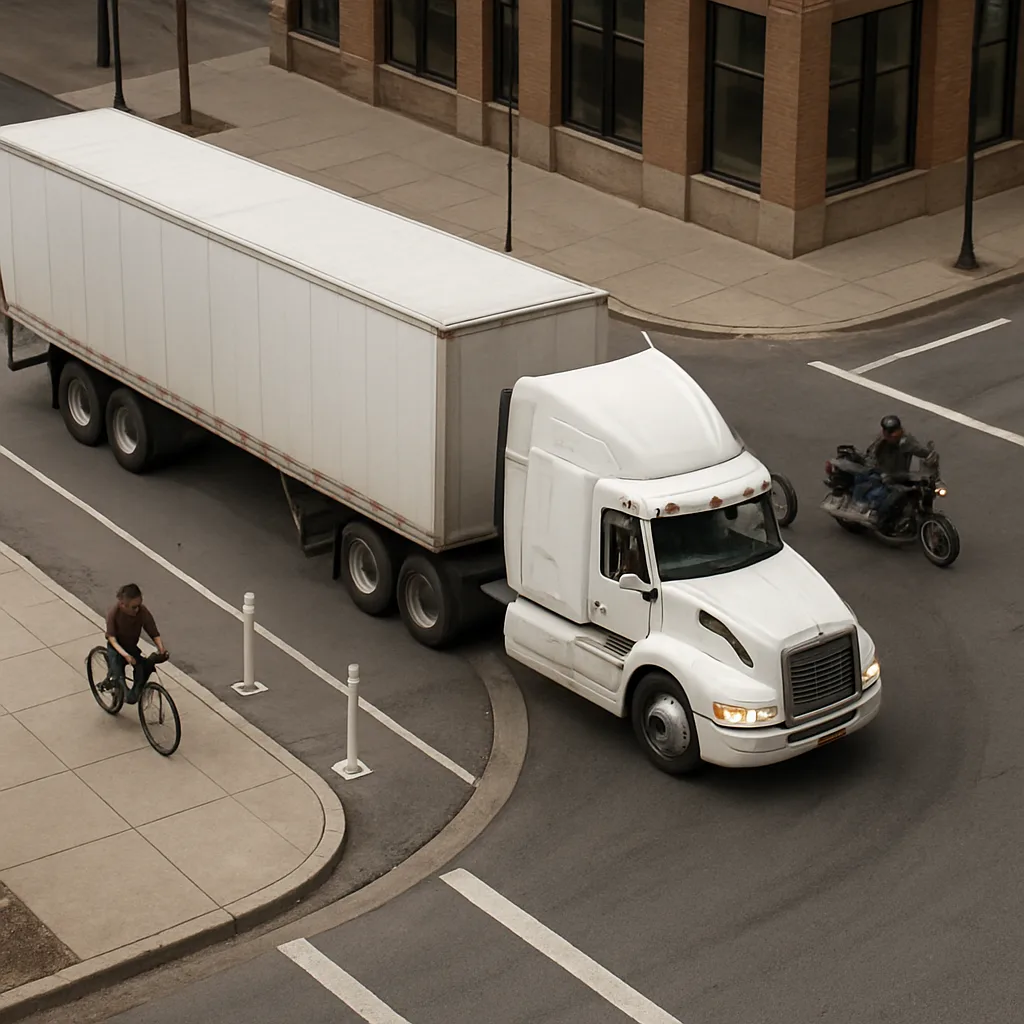
Large commercial vehicles do not turn like passenger cars. A tractor may begin a right turn from a position that appears to leave room, while the trailer’s rear wheels track inside the tractor’s path. This movement is often called off-tracking. A truck may also need additional clearance because of its length, cargo, road design, or the angle of the intersection.
In Chicago, dense traffic, parked vehicles, construction activity, curbside deliveries, and bicycle or motorcycle travel can make that clearance difficult to judge. The physical mechanics of a turn do not by themselves establish fault. The key question is whether the driver and carrier used reasonable care in the circumstances.
Common turning hazards
Potential hazards include:
- A tractor swinging left and then turning right without adequately accounting for nearby traffic.
- A trailer crossing a lane line or encroaching on a curb, crosswalk, bike lane, or shoulder.
- A truck squeezing beside a motorcycle or bicycle before or during the turn.
- Failure to check mirrors and blind spots as the truck changes position.
- Failure to use a turn signal, an inadequate warning, or a signal that was activated too late.
- A driver proceeding when a pedestrian or other road user was already in the truck’s turning path.
A semi truck right turn accident may involve direct contact, a sideswipe, or a rider’s evasive maneuver. A collision is not required for an injury claim; however, the available evidence must connect the conduct to the injury and address any disputed fault.
When the Driver or Carrier May Be Responsible
Responsibility depends on the evidence and the legal relationship between the driver and the trucking company. In Illinois, negligence generally requires examining whether a person or business failed to use reasonable care and whether that failure contributed to the harm. Illinois also uses comparative-fault principles, meaning a person’s own conduct may affect recovery depending on the facts and the allocation of fault.
Possible driver-related issues
A truck driver may be investigated for conduct such as an unsafe turn, inadequate observation, failure to yield when required, excessive speed for the conditions, or failure to maintain a safe distance from a cyclist or motorcyclist. The driver’s training, route, visibility, and understanding of the vehicle’s turning characteristics may also matter.
A wide turn is not automatically improper. Some trucks must swing outward to complete a turn safely. The investigation may instead focus on whether the driver checked the relevant mirrors, signaled appropriately, allowed sufficient clearance, and reacted to a person or vehicle in the danger zone.
Possible carrier-related issues
A motor carrier may face separate questions about its own conduct. Depending on the facts, those questions can include:
- Whether the driver was properly trained for the vehicle and route.
- Whether the carrier had reasonable safety and inspection practices.
- Whether scheduling or dispatch instructions created unsafe pressure.
- Whether company policies addressed interactions with bicycles, motorcycles, and pedestrians.
- Whether the carrier preserved available video, electronic data, inspection records, and communications.
A carrier may also be legally responsible for an employee’s work-related conduct under general agency principles, while an independent-contractor arrangement can create a different analysis. The contract label alone may not resolve every issue. In Chicago, Illinois, a case may involve state-court or federal-court jurisdiction, and the applicable procedures and deadlines can vary.
Evidence That Can Clarify a Truck’s Turning Path
Turning crashes often become disputes about position: Was the motorcycle beside the truck? Did the bicycle enter the crosswalk lawfully? Did the trailer cross the line? Was the turn signal operating? Scene evidence can help answer those questions more reliably than memory alone.
Important sources may include:
- Video and photographs. Traffic cameras, nearby businesses, vehicle dashboard cameras, body cameras, and phone recordings may show the truck’s approach, signal use, lane position, and turn. Images of curb marks, debris, damage, final positions, and sight lines can also help.
- Witness information. Passengers, pedestrians, cyclists, drivers, delivery workers, and other observers may describe what they saw before contact. Their accounts should be preserved while details are still fresh.
- Vehicle and trailer evidence. Damage height, scrape marks, mirror damage, tire marks, and the location of impact can help investigators compare the truck’s path with the injured person’s position.
- Electronic and company records. Depending on the vehicle and system, records may include event data, onboard camera footage, GPS information, dispatch messages, inspection materials, and driver logs. Availability and retention periods differ.
- Roadway conditions. Lane markings, signal timing, construction barriers, parked vehicles, lighting, weather, and intersection geometry may affect what a driver could see and how much room was available.
For a truck cyclist right turn crash in Chicago, the relationship between a bike lane, crosswalk, stop line, and truck’s rear wheels can be especially important. Evidence should be interpreted in context rather than relying on a single photograph or assumption.
People sometimes post photographs or detailed accounts online, move damaged vehicles before documenting them when it is safe to do so, or discard helmets and protective equipment. Those actions can complicate later evaluation. A person involved in a crash may wish to preserve available information and discuss the situation with a qualified Illinois attorney, without assuming that any one step guarantees a legal claim.
Common Mistakes After a Wide-Turn Truck Crash
The first priority after a collision is safety and appropriate medical attention. A person should avoid diagnosing an injury or assuming that pain will resolve without professional evaluation. Records from emergency responders, medical providers, and repair professionals may later help establish what happened and the effects of the collision.
Other issues commonly arise during a claim:
- Assuming the truck driver’s explanation ends the inquiry. A driver’s account is one piece of evidence. Video, physical marks, signal data, and independent witnesses may tell a different or more complete story.
- Speaking casually with an insurer. Insurance representatives may request information about the crash. It is useful to understand what is being asked and how statements may be used before providing a detailed recorded account.
- Overlooking the carrier. The truck may display one business name while another company owns the trailer, employs the driver, arranges the load, or provides insurance. Identifying the relevant parties can require investigation.
- Waiting too long to preserve evidence. Video systems may overwrite footage, vehicles may be repaired, and roadway conditions may change. In Illinois, deadlines for personal injury claims can be affected by the circumstances, the parties involved, and the type of claim.
- Assuming fault is obvious. Illinois courts may examine the conduct of everyone involved, including a driver, motorcyclist, bicyclist, pedestrian, carrier, maintenance provider, or another party.
An attorney evaluating a commercial vehicle turning liability question may review the crash report, photographs, medical records, insurance information, vehicle data, and the truck’s ownership and employment relationships. The goal is to develop a fact-based analysis, not to presume responsibility before the evidence is examined.
Frequently Asked Questions
Can a truck be responsible if it did not hit my motorcycle directly?
Potentially. A truck’s turn may force a motorcyclist to brake, swerve, or fall even without direct contact. Whether another party may be responsible depends on evidence showing that the truck’s movement or warning practices were unreasonable and contributed to the event. Investigators may review video, witness accounts, roadway layout, vehicle positions, and the actions of all road users under Illinois law.
What makes a truck off-tracking accident different from an ordinary car crash?
Off-tracking means a trailer’s rear wheels follow a tighter path than the tractor during a turn. That geometry can place the trailer closer to a curb, bike lane, crosswalk, or adjacent lane than a nearby road user expects. The investigation may require measurements, vehicle-damage analysis, and review of the truck’s turning clearance rather than focusing only on the tractor’s initial position.
Does a turn signal prove the truck driver was not negligent?
No. A working and timely signal may be relevant, but it does not by itself establish that the turn was safe. The driver may still need to account for nearby vehicles, motorcycles, bicycles, and pedestrians, maintain appropriate clearance, and complete the maneuver with reasonable care. The significance of the signal depends on timing, visibility, traffic conditions, and other evidence.
Can a carrier be involved when the driver was not its direct employee?
Possibly, but the analysis depends on the facts. Investigators may examine contracts, control over the driver’s work, vehicle ownership, dispatch arrangements, insurance, and the conduct that caused the crash. Illinois law and the forum handling the case can affect how these relationships are evaluated. A qualified attorney can explain the potential issues after reviewing the available information.
How Dinizulu Law Group Can Help
Dinizulu Law Group is dedicated to helping injured people understand the facts and legal issues surrounding truck, motorcycle, bicycle, pedestrian, and other personal injury claims. The firm can evaluate questions involving trailer off-tracking, mirror visibility, turn signals, roadway design, carrier relationships, and the preservation of evidence.
The team is committed to fighting for clients’ rights while presenting a careful, fact-based case assessment. If you or a family member was injured in a wide-turn truck crash in Chicago, contact Dinizulu Law Group for a free consultation or case evaluation and to discuss your legal options.
The information in this article is for educational purposes only and does not constitute legal advice. Contact a qualified attorney licensed in Chicago, Illinois for advice specific to your situation.


