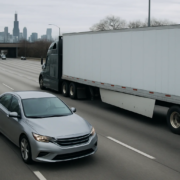
Chicago Truck Blind Spot Accident Lawyer: Lane Changes
A truck moves beside you on the Kennedy Expressway, Dan Ryan Expressway, Lake Shore Drive, or another busy Chicago route. You notice the trailer drifting toward your lane, but there may be little time to react. After contact, the truck may continue forward while you are left trying to understand how the collision happened. If you are searching for a Chicago truck blind spot accident lawyer, understanding the evidence can help you describe the event clearly.
Truck Blind Spot Accidents in Chicago: Proving a Dangerous Lane Change in Chicago, Illinois requires more than showing that two vehicles touched. The key questions may include where each vehicle was positioned, whether the truck driver checked mirrors, whether a signal was used, how fast the truck moved, and whether the driver had a reasonable opportunity to see the car. Dinizulu Law Group provides legal guidance for people evaluating these issues. This article explains what makes truck blind spots dangerous, what evidence may help establish a hazardous lane change, and mistakes that can make the facts harder to prove.
How Chicago Truck Blind Spot Accidents Develop During Lane Changes
Commercial trucks have large areas around the cab and trailer where a nearby vehicle may be difficult or impossible for the driver to see through ordinary mirrors. These areas can change as the truck turns, merges, or passes another vehicle. A car traveling alongside a trailer may remain in a blind zone for several seconds, particularly when traffic is dense.
A blind spot alone does not automatically establish legal responsibility. The analysis generally focuses on the driver’s conduct and the circumstances of the maneuver. Important facts may include whether the driver checked properly adjusted mirrors, activated a turn signal, maintained a safe speed, allowed enough space, and changed lanes only when the movement could be made safely.
Why mirror setup and timing matter
Truck drivers often rely on multiple mirrors, including wide-angle equipment designed to reduce blind areas. Even with that equipment, mirrors must be checked at appropriate times. A driver who looks too early, fails to look again before moving, or begins a lane change before a nearby car clears the truck may not recognize the danger.
Timing also matters. A truck that begins moving over as a car enters the trailer’s side area presents a different factual question from a truck that has been beside the car for an extended period. Photos, vehicle positions, witness observations, and available video may help reconstruct that sequence.

Evidence That May Prove a Dangerous Truck Lane Change in Chicago
A sideswipe can leave limited physical evidence, especially if the vehicles remain drivable or leave the scene before police arrive. Still, several sources may help show how the collision occurred. In Chicago, Illinois, the location and timing of the crash can affect whether traffic-camera footage, nearby business video, or roadway records exist and how long those materials are retained.
Useful evidence may include:
- Photographs showing damage along the car’s side, the truck’s tractor or trailer, paint transfer, broken mirror parts, and debris locations.
- A diagram or written description showing the lanes, direction of travel, approximate positions, and point of impact.
- Names and contact information for people who saw the truck move, heard a horn, observed a signal, or saw what happened afterward.
- Dashcam, rideshare, delivery-vehicle, nearby-business, or traffic-camera footage, when available.
- The police crash report and any photographs or statements collected by the Chicago Police Department or Illinois State Police.
- Truck inspection, electronic logging, dispatch, maintenance, or onboard-camera records that may bear on the trip and vehicle condition.
What damage patterns may show
Damage running along a car’s side may be consistent with contact during a lane change, but photographs do not prove the entire claim by themselves. The height, direction, length, and location of the damage can help an attorney or qualified investigator compare the physical evidence with each driver’s account. A professional inspection may be important before repairs alter the evidence.
Whether the truck stopped is also relevant. A stopped driver may have exchanged information, spoken with witnesses, or reported the event. If the truck continued, witnesses, video, vehicle-identification details, and prompt reporting may become especially important. A failure to stop should not be assumed from one person’s initial impression; the available evidence and applicable Illinois law must be evaluated carefully.
Illinois Claims, Documentation, and Common Mistakes After a Truck Sideswipe
In Illinois, a personal injury or property-damage claim generally requires evidence connecting the other party’s conduct to the collision and the losses being claimed. Depending on the facts, potentially responsible parties may include the truck driver, a motor carrier, a vehicle owner, or another entity. Responsibility is fact-specific. Employment relationships, contracts, maintenance duties, and the driver’s actions may all matter.
Chicago-area collisions may involve claims handled in the Circuit Court of Cook County or other Illinois courts, depending on the parties and circumstances. Illinois law includes deadlines and comparative-fault rules that can affect a claim, and those rules may change. An attorney licensed in Illinois can assess which procedures and deadlines apply to a particular situation.
Steps that may preserve useful information
Generally speaking, a person involved in a truck sideswipe may find it useful to:
- Seek appropriate medical attention and keep records of care, without assuming that the absence of immediate symptoms establishes the absence of injury.
- Photograph the vehicles, road surface, lane markings, surrounding area, and visible debris when it is safe to do so.
- Write down the route, lane positions, traffic conditions, approximate timing, truck description, and what happened after impact.
- Preserve original photos, videos, vehicle data, repair estimates, insurance correspondence, and witness information.
- Avoid guessing about speed, signaling, or fault when speaking with insurers or posting publicly.
A common mistake is repairing or discarding a damaged vehicle before documenting it. Another is waiting too long to identify surveillance footage, because private businesses and public agencies may retain recordings for limited periods. Legal representation is not required in every matter, but a lawyer may help organize evidence, communicate with insurers, and evaluate whether additional records should be requested or preserved.
Frequently Asked Questions
What if the truck driver says I was in the blind spot?
Being in a truck’s blind spot does not automatically make the car driver responsible. The facts may include how long the vehicles traveled alongside each other, whether the car was lawfully positioned, whether the truck signaled, and whether the truck driver checked mirrors before moving. Illinois fault rules can reduce or affect recovery based on the parties’ respective conduct, so the evidence should be reviewed as a whole.
Can a truck company be involved in a Chicago sideswipe claim?
Possibly. Depending on the facts, a motor carrier or vehicle owner may have responsibilities connected to the driver’s work, truck maintenance, training, dispatch, or recordkeeping. Whether another entity is legally responsible depends on issues such as the driver’s relationship with the company and the conduct that contributed to the collision. A Chicago personal injury attorney can evaluate those relationships and the available records.
What if I do not know the truck’s license plate or company name?
A claim may still be investigated using other details. Useful information can include the truck’s color and configuration, trailer markings without trying to recreate unreadable text, direction of travel, location, approximate time, witness accounts, photographs, and nearby video. Promptly preserving this information may help identify the vehicle. A lack of a complete plate number can make the investigation more difficult, but it does not by itself answer whether recovery is possible.
Does a police report decide who caused the crash?
A police report can provide important information, including statements, diagrams, officer observations, and the reported location. It is not necessarily the final determination of civil responsibility. Reports may contain incomplete or disputed accounts, particularly when one vehicle leaves before officers arrive. Insurance companies and courts may consider the report along with photographs, video, witness testimony, vehicle inspections, and other evidence.
How Dinizulu Law Group Can Help
Dinizulu Law Group is dedicated to helping Chicago-area clients understand the evidence and legal issues that may arise after a commercial truck collision. The firm is committed to fighting for clients’ rights while carefully evaluating lane positions, damage patterns, witness accounts, available video, medical documentation, and insurance communications.
If you or a family member has been involved in a truck sideswipe or dangerous lane-change collision, Dinizulu Law Group is ready to evaluate your situation. Contact the firm for a free consultation or case evaluation and to discuss your legal options.
The information in this article is for educational purposes only and does not constitute legal advice. Contact a qualified attorney licensed in Chicago, Illinois for advice specific to your situation.


