Which Facts Shape Liability in Chicago Truck Dooring Cases?
A cyclist riding beside a parked delivery truck may have little warning if a door swings into the bicycle’s path. In Chicago, truck dooring accident liability can depend on more than the contact itself: where the truck stopped, what it was doing, who opened the door, and whether the cyclist had room to respond all may matter. Dinizulu Law Group helps readers understand the questions that can arise after a commercial vehicle crash. This article explains how the stop and door opening may be evaluated, who could potentially share responsibility, and how witness, camera, and loading evidence may help establish what happened. It also discusses practical ways to preserve information after an injury, without assuming that any one account or piece of evidence decides a claim.
How Chicago truck dooring accident liability may be assessed
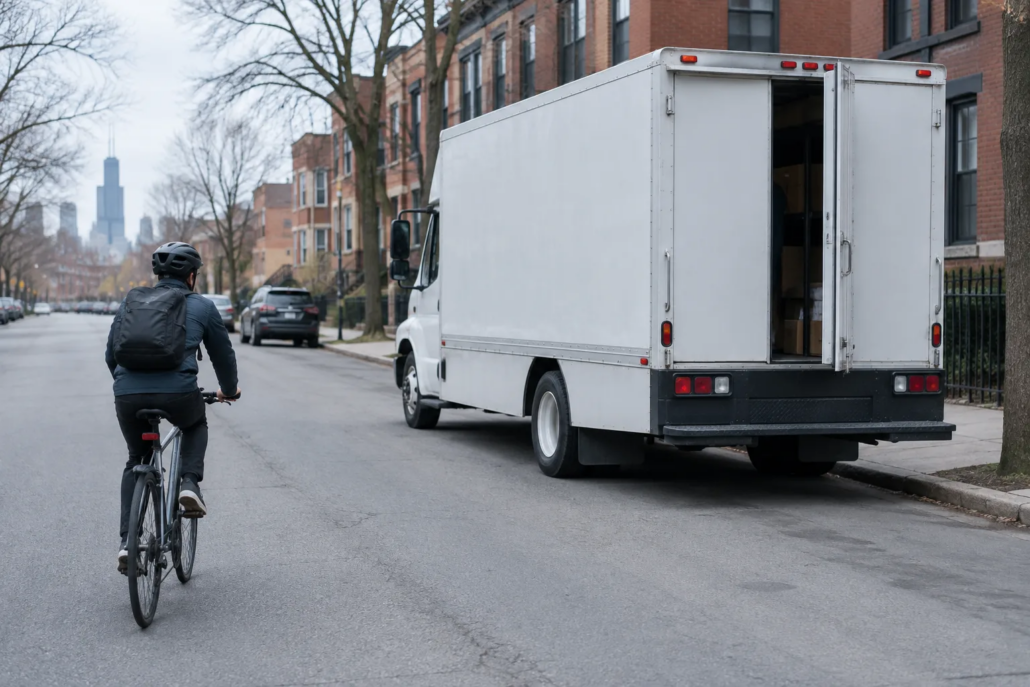
A dooring collision involves a door opening into a cyclist’s path. The circumstances may be different from a crash involving a moving truck: the vehicle might be parked, stopped briefly for a delivery, or positioned partly within a bike lane. Investigators may consider whether the truck’s location was appropriate, how long it had been stopped, and whether the person opening the door could see approaching bicycle traffic.
Who may be responsible when a truck door hits a cyclist?
The person who opened the door may be one source of responsibility, but that does not resolve every case. The driver may have selected a stopping place that restricted the cyclist’s path, or a delivery company may have relevant duties depending on its role and the facts. A company is not automatically liable merely because its truck was involved. Reviewing the possible roles of parties who may share responsibility for a truck accident can help frame the question without presuming the answer.
Chicago truck dooring investigations may also distinguish a door opening from a moving-vehicle collision. If the truck was turning rather than stationary, the sequence and applicable safety questions may differ; Chicago truck right-turn bicycle collisions involve a separate mechanism. The cyclist’s position, speed, visibility, and available space can be relevant, too. Illinois traffic and negligence rules may apply, and the facts must be assessed under the law that governs the particular incident.
What evidence can clarify a Chicago truck dooring crash?
A reliable account often depends on reconstructing a short sequence: where the truck was, when the door opened, where the cyclist was riding, and whether anything obstructed either person’s view. Physical details can help test differing memories. For example, investigators may document the truck’s final position, the bicycle lane’s width and condition, curbside obstructions, and whether the truck was loading or unloading.
Witnesses may have seen the door open or heard the impact. Nearby storefront, building, or vehicle cameras may have captured some of the event, although footage availability and retention periods can vary. Photos taken safely at the scene can show lane markings, parked vehicles, construction barriers, weather, lighting, and sightlines. The bicycle and truck may also have physical marks that help explain where contact occurred.
Loading and dispatch records may provide context about why the vehicle stopped and where it was expected to make a delivery. Those records are different from direct evidence of the door opening, but they can help establish the truck’s purpose and location. Depending on the circumstances, records from a Chicago delivery-truck loading crash may shed light on delivery activity. For more on sequence, vehicle position, and accounts of who opened the door, see this guide to Chicago truck dooring investigations.
Preserving evidence and understanding the claim process
After a cyclist is injured, immediate priorities can include getting appropriate medical attention and making sure the scene is safe. When circumstances permit, useful details to record may include:
- The truck’s position relative to the curb and bicycle lane.
- The direction the cyclist was traveling and the available riding space.
- The name or contact information of any witness who is willing to provide it.
- Nearby cameras that might have recorded the scene.
- Photos of visible conditions, the bicycle, and the vehicle, if safe to take.
A person’s recollection can become less precise over time, and video may not remain available indefinitely. Still, no single type of evidence is essential in every case. A police report, a witness statement, or a video clip may help, but each should be considered alongside other information and the applicable Illinois law. General steps to take after a truck accident can help readers think about documentation and follow-up without replacing advice tailored to their situation.
In Chicago, the investigation may also need to account for busy curbside conditions, including delivery activity, parked vehicles, construction, and changes in lane markings. The cyclist’s route and the truck’s stopping choice should be considered together rather than in isolation. Illinois rules about fault and recovery can be fact-specific, and laws may vary by location or change over time. An attorney can review available evidence and explain how those rules may apply.
Frequently Asked Questions
Can a truck driver be responsible if someone else opened the door?
Possibly, depending on the facts. The driver’s choices about where and how to stop may be relevant, even if another person opened the door. The person who opened it, the driver, and a company may each have different roles. Responsibility is not automatic for any of them; an assessment may consider the truck’s position, the sequence of events, and the duties that apply under Illinois law.
Does riding outside a marked bike lane automatically prevent a cyclist from bringing a claim?
Not necessarily. The cyclist’s location and the condition of the bicycle lane may be important, but they are only part of the overall circumstances. An obstruction, road work, a parked vehicle, or another curbside condition may affect the cyclist’s path. How fault is evaluated depends on the evidence and applicable Illinois law, so a lane position alone may not answer whether a claim is available.
What if there were no witnesses to the door opening?
A claim does not necessarily depend on an eyewitness. Photos, physical marks, camera footage, vehicle or delivery records, and accounts given soon after the incident may help establish what occurred. Evidence may be incomplete, and each item has limits. A legal review can consider whether different sources fit together and whether additional information may be available.
Could a delivery company be involved in a truck dooring claim?
It could be, depending on its relationship to the truck, the driver, and the delivery activity. The company’s role, control over the work, and relevant policies or records may warrant review, but involvement in a delivery does not by itself establish liability. The facts and applicable law determine whether a company or another party may bear responsibility.
How Dinizulu Law Group Can Help
Dinizulu Law Group is dedicated to helping injured people understand the issues that can arise after a Chicago truck dooring crash. The firm can evaluate how the truck stopped, who may have opened the door, the cyclist’s route, and what witness, camera, or delivery evidence may be available. Every situation is different, and an evaluation does not guarantee a particular result. If a commercial vehicle dooring incident injured you or someone close to you, contact Dinizulu Law Group to discuss your circumstances and request a free consultation or case evaluation.
The information in this article is for educational purposes only and does not constitute legal advice. Contact a qualified attorney authorized to practice in the jurisdiction that applies to your matter for advice specific to your situation.


Leave a Reply
Want to join the discussion?Feel free to contribute!