Best Evidence After a Car Accident That Counts
A crash can leave you shaken, hurt, and pressured to make decisions before you have had time to process what happened. The best evidence after a car accident is often gathered in the first hours and days, when the physical scene, witness memories, and digital records are still available. But protecting a claim should never come before your medical safety.
If you were injured in Chicago or elsewhere in Illinois, evidence may determine whether an insurer accepts responsibility, minimizes your injuries, or tries to blame you for the collision. Strong proof gives your account weight. It also helps tell the full human story of how a negligent driver changed your health, work, family life, and future.
Start With Safety and Medical Care
Call 911 after a crash involving injuries, significant property damage, a suspected impaired driver, or an unsafe roadway. Accept medical evaluation when it is offered. Adrenaline can mask pain from a concussion, neck injury, internal injury, or soft-tissue damage, and waiting too long to seek care may give an insurance company an opening to argue that you were not seriously hurt.
Medical records are not just paperwork. They connect the collision to your symptoms, diagnosis, treatment, limitations, and prognosis. Be honest with every provider about where you hurt, how the crash happened, and whether symptoms worsen. Follow the treatment plan, attend appointments when you can, and tell your provider if pain affects sleep, mobility, work, or daily activities.
Do not let the need for evidence put you in danger. If you cannot take photos or speak with witnesses because you are injured, ask a trusted person to help if possible. Law enforcement, emergency personnel, and later investigation can still provide critical proof.
The Best Evidence After a Car Accident Is Often Visual
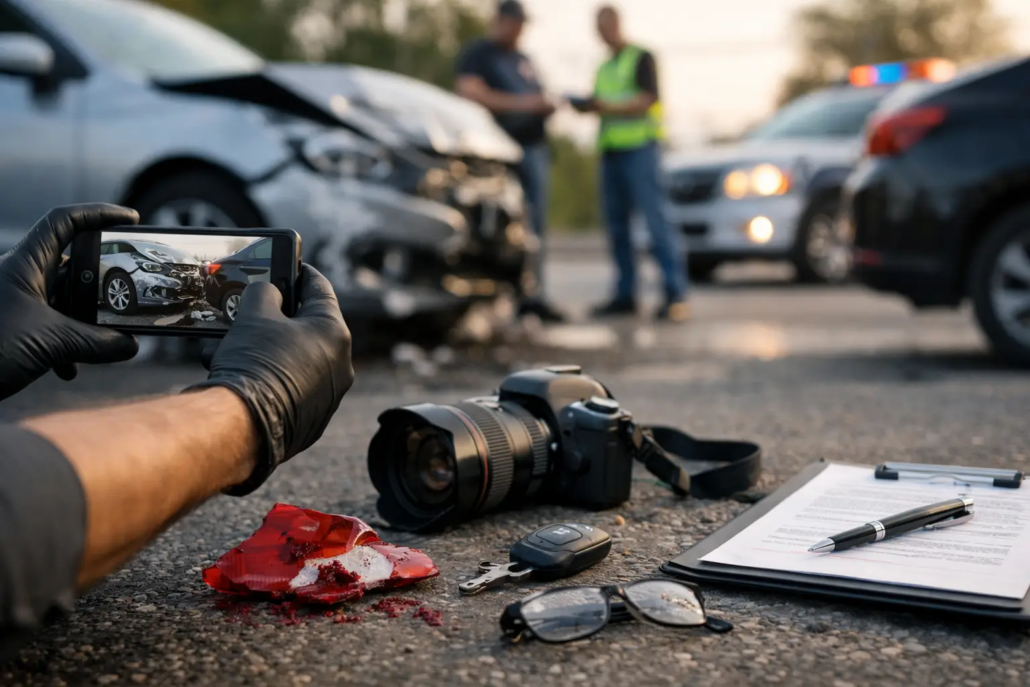
Photos and video taken soon after a collision can preserve details that disappear quickly: vehicle positions, debris, skid marks, broken glass, weather, traffic signals, road construction, and visible injuries. Take wide shots that show the overall scene and closer images of the damage to every vehicle involved.
Photograph the other driver’s license plate, insurance information, driver’s license, and vehicle make and model when it is safe to do so. If there are nearby businesses, residences, transit vehicles, or intersections with cameras, capture their locations. Security footage may be overwritten within days, sometimes even sooner.
Do not edit photos, add filters, or delete images because they seem unflattering or repetitive. Keep the original files and back them up. The date, time, and location data associated with a photo can matter. A short video walking around the scene may also capture details still photos miss, including traffic flow, lighting, and the condition of the roadway.
What Vehicle Damage Can Show
Damage photographs can help accident reconstruction experts assess the angle and force of impact. They may support an account of a rear-end collision, unsafe lane change, left-turn crash, sideswipe, or failure to yield. Property damage alone does not measure the seriousness of an injury, however. A person can suffer substantial harm even when a vehicle shows limited visible damage.
Keep repair estimates, towing invoices, storage bills, and photographs taken before repairs. If the vehicle is declared a total loss, ask before agreeing to dispose of it. In some cases, preserving the vehicle for inspection is necessary.
Get the Police Report, but Do Not Treat It as the Whole Case
A police report is an important starting point. It generally identifies the drivers, vehicles, insurance information, witnesses, responding officers, apparent roadway conditions, and sometimes traffic citations or an officer’s initial observations.
Still, a report can contain mistakes. An officer may arrive after the vehicles have been moved, receive conflicting accounts, or leave out a witness’s statement. Review the report carefully once it is available. If information is wrong, do not assume the error cannot be addressed. Your attorney can evaluate whether additional evidence, witness testimony, video, or a supplemental report may help correct the record.
A citation against the other driver can be helpful, but it is not required to prove negligence. Likewise, the absence of a citation does not mean you do not have a claim.
Witnesses Can Resolve the Dispute Insurers Create
Independent witnesses are especially valuable when drivers disagree about who had the green light, who changed lanes, or who was speeding. If a witness is willing, ask for their name, phone number, email address, and a brief description of what they saw. A witness who says, “I saw the truck run the red light,” may be far more useful than someone who only arrived after impact.
Do not coach a witness or ask them to exaggerate. Credibility matters. The goal is to preserve a truthful, firsthand account before memories fade or contact information changes.
If you learn that someone recorded the collision on a phone, ask them to save the original video. A social media post may be deleted, compressed, or stripped of useful data. Original files are better.
Digital Records May Tell the Story No One Saw
Many serious collisions now involve evidence beyond the roadway. Depending on the circumstances, a claim may involve traffic-camera footage, nearby surveillance video, dashcam recordings, vehicle event data recorders, phone records, rideshare data, or commercial truck electronic logs.
This evidence often has a short life. Businesses may overwrite surveillance footage in days or weeks. A trucking company may control records that help show speed, braking, driver hours, maintenance failures, or route information. Prompt legal action can be necessary to demand that evidence be preserved before it disappears.
Be cautious with your own social media after a crash. Insurers and defense lawyers may review public posts and try to use a smiling photo, a family outing, or an incomplete caption to question the extent of your injuries. You do not need to stop living your life, but avoid posting about the accident, your symptoms, settlement discussions, or physical activities while your claim is pending.
Keep Records of the Harm You Cannot Photograph
The strongest case is not limited to proving that another driver caused the crash. It must also show what the crash has cost you. Create a simple folder, paper or digital, for medical bills, prescriptions, work restrictions, pay stubs, repair documents, insurance letters, and receipts for expenses such as transportation to appointments.
A private injury journal can also be meaningful evidence. Brief entries about pain levels, missed work, difficulty lifting a child, disrupted sleep, anxiety while driving, or missed family events can help document changes that do not appear on an X-ray. Write truthfully and consistently. You are preserving your experience, not trying to create a dramatic record.
For a fatal crash, families may need records that show the loved one’s relationship with children, spouse, parents, and household members, as well as financial support and the loss of guidance and companionship. No document can measure that loss completely, but careful records help ensure the person is not reduced to a number on an insurance spreadsheet.
Avoid Giving the Insurer Evidence Against You
The other driver’s insurer may call quickly and sound helpful. Remember that its financial interest is different from yours. You can provide basic identifying information, but be careful about recorded statements, broad medical authorizations, and early settlement offers before you understand your injuries.
Do not guess about speed, distances, fault, or the extent of your recovery. A casual statement such as “I’m fine” can be repeated later, even if you were speaking out of shock at the scene. Never admit fault simply because you feel upset that the crash happened.
Illinois follows a modified comparative negligence rule. In many cases, an injured person may recover damages if they are not more than 50 percent responsible, but their recovery can be reduced by their share of fault. That makes accurate, early evidence particularly important when an insurer attempts to shift blame.
When to Ask for Legal Help
You should consider speaking with a car accident attorney promptly when injuries are serious, fault is disputed, a commercial vehicle was involved, a loved one died, or an insurer is pressuring you to settle. The same is true when you believe video footage, vehicle data, or other proof may be lost.
A lawyer can investigate the crash, preserve evidence, identify every responsible party, calculate the full value of damages, and handle insurer communications while you focus on healing. At Dinizulu Law Group, we believe accountability should not depend on who has more resources, who speaks loudest, or who an insurer expects to give up.
You do not have to collect every piece of proof perfectly while you are in pain. Take care of yourself, keep what you can, and ask for help early. Evidence can protect a claim, but it can also protect something more personal: your right to be heard with dignity and treated fairly after someone else’s negligence turns your life upside down.


