Could a Parked Truck Matter to a Chicago Crash Lawyer?
A truck stopped along a Chicago street can create a serious visibility problem even when it is not moving. A driver may come upon the vehicle near an intersection, crosswalk, bike lane, shoulder, or active loading area with little time to react. If you are searching for a Chicago parked truck accident lawyer, the central question is usually not simply whether the truck was parked. It is whether the truck’s position, condition, warnings, or related activity unreasonably contributed to the crash.
Dinizulu Law Group provides guidance to people evaluating truck and auto accident claims in Chicago, Illinois. This article explains how sight-line obstructions may affect fault, what evidence can help clarify what happened, which parties may be involved, and why these cases can require careful investigation.
When Can a Parked Truck Create a Visibility Hazard in Chicago?
A stopped or parked commercial vehicle may become part of a collision analysis when it blocks a person’s view of traffic, pedestrians, cyclists, traffic signals, or roadway conditions. The fact that a truck was stationary does not automatically establish liability. Investigators generally examine where it was positioned, why it was there, how long it remained there, and whether the operator or company took reasonable precautions.
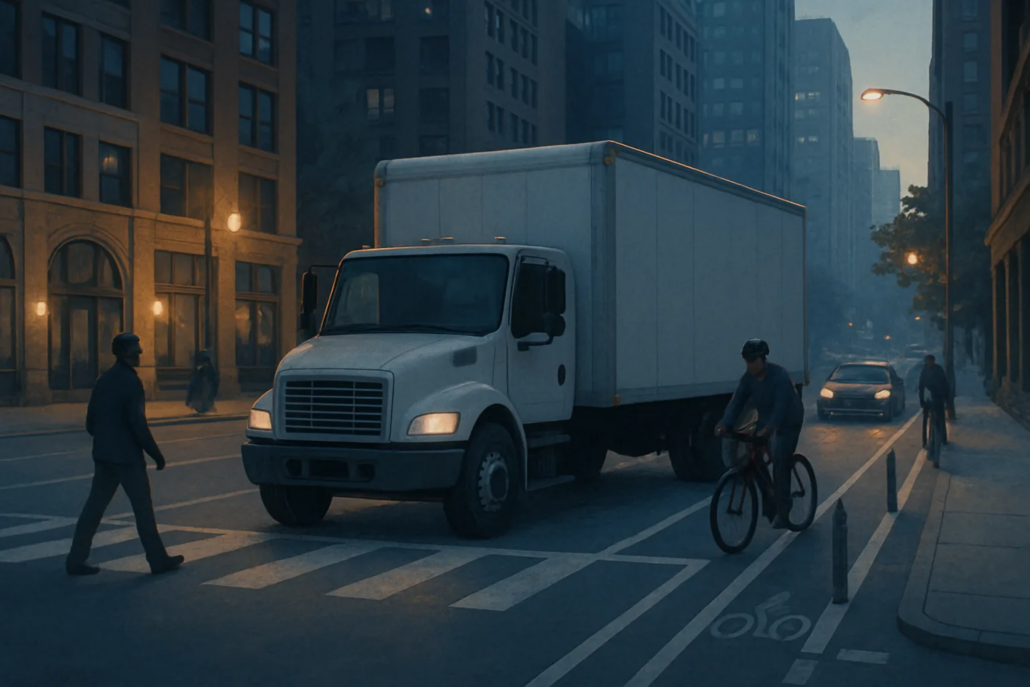
In Chicago, Illinois, dense traffic, narrow streets, construction activity, and frequent deliveries can make vehicle placement especially important. A truck near a corner may obstruct a driver’s view of vehicles approaching from the cross street. A truck beside a bike lane may make it harder for a turning driver to see a cyclist. A disabled truck on a shoulder may also create a sudden obstruction if its lights, reflectors, or warning devices are not reasonably visible.
Circumstances investigators may examine
Potential questions include:
- Was the truck stopped where parking or stopping was restricted?
- Did it block a crosswalk, intersection approach, bike lane, travel lane, or driveway?
- Were hazard lights, reflective devices, cones, or other warnings used when appropriate?
- Was the truck visible in the available lighting and weather conditions?
- Was loading, unloading, backing, or door-opening activity taking place?
- Did the vehicle’s size create a sight-line problem that a smaller vehicle would not?
The surrounding facts matter. A delivery truck making a brief stop may present different issues from a tractor-trailer left in a travel lane or a disabled vehicle without visible warnings.
How Is Fault Evaluated After a Truck-Stopped-in-the-Roadway Accident in Chicago?
A truck-stopped-in-the-roadway accident in Chicago may involve more than one potentially responsible person or entity. Depending on the facts, review may include the truck driver, vehicle owner, motor carrier, delivery company, maintenance provider, property owner, or another party connected to the stop. Responsibility is fact-specific and should not be assumed from the presence of the truck alone.
Illinois negligence claims generally require an analysis of duty, unreasonable conduct, causation, and legally recognizable harm. Illinois also uses comparative-fault principles, meaning the conduct of multiple parties may be considered when assigning responsibility. A driver who strikes an obstruction may still face questions about speed, attention, lane position, or following distance, while the truck operator or company may face questions about placement, warnings, or loading procedures.
Evidence that may clarify the visibility issue
Useful evidence can include:
- Scene photographs and measurements: Images from the driver’s approach can show what was visible before the collision. Photos taken at several distances may be more useful than a single picture taken after vehicles were moved.
- Video and electronic records: Traffic cameras, nearby security footage, dashcam recordings, and available vehicle data may help establish the truck’s position and timing.
- Witness accounts: People near a bus stop, storefront, loading area, or intersection may have observed whether warnings were present or whether the truck blocked a sight line.
- Company records: Dispatch information, delivery instructions, driver communications, inspection records, and incident reports may help explain why the truck stopped and what precautions were considered.
- Roadway and lighting conditions: Weather, construction barriers, street illumination, lane markings, and nearby parked vehicles can affect what each road user could reasonably see.
The Circuit Court of Cook County may handle civil litigation arising from a Chicago collision, but the proper court and procedural path depend on the parties, claims, and amount at issue. A Chicago parked truck accident lawyer can help organize evidence and assess which legal theories may fit the available facts.
What Mistakes Can Weaken a Commercial Vehicle Visibility Claim?
Visibility cases can become difficult when the physical scene changes quickly. The truck may be moved, loading equipment removed, warning devices collected, or roadway conditions altered before photographs or measurements are taken. Witnesses may also leave before their contact information is obtained.
People involved in a crash may also unintentionally make the investigation harder by focusing only on vehicle damage. Damage photographs are important, but they may not show what the driver could see before impact. A complete review may also require documenting the approach path, obstruction height, lane configuration, lighting, nearby signs, and the positions of other vehicles.
Common issues to avoid include:
- Assuming a parked truck cannot be legally responsible because it was not moving.
- Assuming the truck is automatically at fault because it was stopped near the crash site.
- Discarding photographs, dashcam files, delivery information, or repair records.
- Giving a detailed recorded statement before understanding what evidence exists.
- Waiting too long to explore deadlines, insurance coverage, and preservation of evidence.
- Overlooking injuries involving pedestrians, cyclists, passengers, or other drivers affected by the obstruction.
A lawyer evaluating a delivery truck illegally parked crash may compare driver statements with photographs, surveillance, traffic-control information, and company records. The review may also consider whether the truck was disabled, whether the stop was connected to a delivery, and whether the operator had a reasonable opportunity to warn approaching road users.
Depending on the circumstances, an attorney may discuss communicating with insurers, preserving evidence, identifying potentially responsible parties, and evaluating damages. These discussions are educational until a licensed attorney reviews the specific facts and applicable Illinois law.
Frequently Asked Questions
Does a parked truck have to violate a parking rule before it can be part of a liability claim?
No. A parking or stopping violation may be important evidence, but liability does not necessarily depend on proving a citation. The broader question is whether the truck’s location or related conduct created an unreasonable risk and contributed to the collision. Chicago rules, Illinois law, roadway design, lighting, warnings, and the conduct of other road users may all be relevant.
Can a truck company be involved in a Chicago visibility-hazard claim?
Potentially. The facts may raise questions about the driver, vehicle owner, employer, motor carrier, delivery company, or another entity. For example, dispatch instructions, delivery timing, training, inspection practices, and company policies may help explain why the truck stopped or whether precautions were expected. Whether a company has legal responsibility depends on the evidence and the applicable Illinois rules.
What if the truck was stopped because it had broken down?
A breakdown may explain why a truck was stopped, but it does not answer every safety question. The investigation may consider whether the truck could be moved safely, whether warning devices or lights were visible, and whether the location created an unusual hazard. Mechanical failure, emergency circumstances, weather, and the time available to respond may all affect the analysis.
Are bicycle and pedestrian crashes treated differently when a truck blocks visibility?
They may involve different facts and evidence. A truck positioned beside a bike lane or near a crosswalk can affect how drivers, cyclists, and pedestrians perceive one another. Investigators may examine turning movements, crossing locations, traffic controls, lighting, and whether the truck obstructed a lawful path of travel. The potential claims and defenses depend on the particular collision.
How Dinizulu Law Group Can Help
Dinizulu Law Group is dedicated to helping Chicago, Illinois, residents understand the issues that may arise after truck, delivery vehicle, and auto collisions. The firm can evaluate questions involving blocked sight lines, stopped commercial vehicles, warning measures, loading activity, insurance communications, and evidence preservation.
The team is committed to fighting for clients’ rights while recognizing that each case depends on its own facts, available proof, and applicable Illinois law. If a parked or stopped truck may have contributed to your collision, contact Dinizulu Law Group for a free consultation or case evaluation to discuss your situation and legal options.
The information in this article is for educational purposes only and does not constitute legal advice. Contact a qualified attorney licensed in Chicago, Illinois for advice specific to your situation.


Leave a Reply
Want to join the discussion?Feel free to contribute!