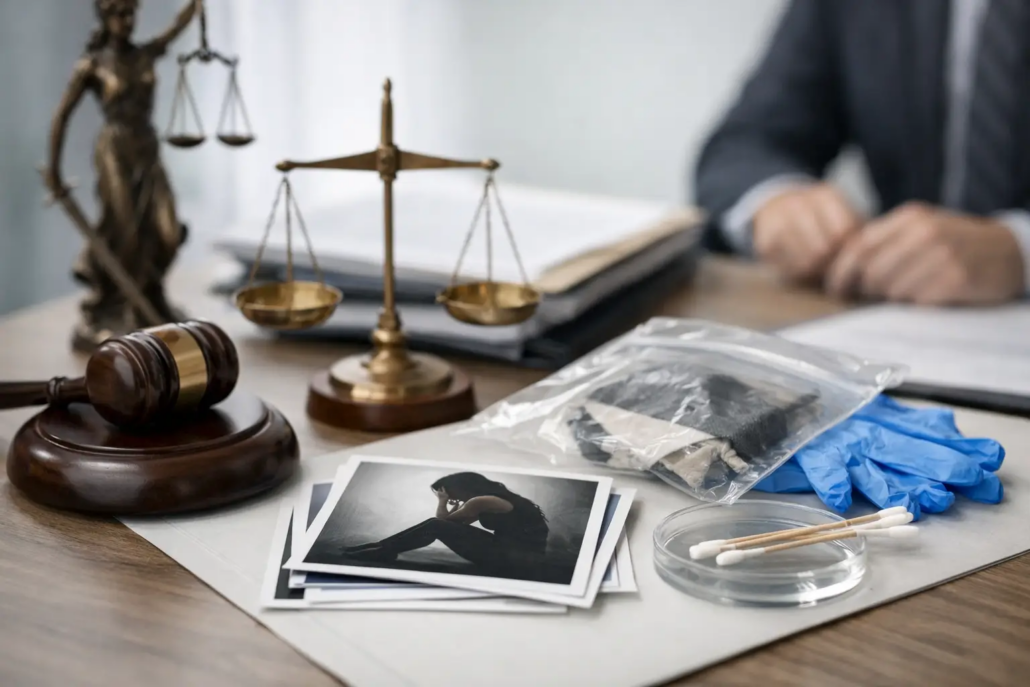
Evidence in Sexual Abuse Cases Explained
Sexual abuse cases rarely begin with a neat stack of proof. More often, they begin with a person finally deciding to speak after fear, shame, confusion, or years of pressure to stay silent. That is why evidence in sexual abuse cases must be understood in a real-world way – not through myths about what “perfect” proof looks like, but through how abuse actually happens and how survivors actually come forward.
In civil sexual abuse claims, evidence is about showing what happened, who is responsible, and how the abuse changed a person’s life. Sometimes the evidence is immediate and physical. Sometimes it is historical and institutional. Sometimes the strongest proof is a pattern that only becomes clear when records, witness accounts, and survivor testimony are examined together.
What counts as evidence in sexual abuse cases?
Many people assume evidence means DNA, photographs, or a medical exam taken right after an assault. Those forms of proof can matter, but they are not the whole picture. In many sexual abuse cases, especially those involving children, trusted authority figures, family members, clergy, teachers, coaches, health care workers, or institutional settings, the abuse may go unreported for months or years.
That delay does not make the claim less valid. It simply changes the type of evidence that may be available.
Evidence can include a survivor’s own account, statements made to friends or family, therapy records, text messages, emails, social media communications, school or employment records, medical records, prior complaints against the abuser, personnel files, police reports, and documents showing that an institution ignored warning signs. In some cases, financial records, travel records, building access logs, or internal investigation files can help establish opportunity, knowledge, or concealment.
The key legal question is not whether a case looks like a television crime show. The question is whether the available evidence, taken together, supports the survivor’s account and shows liability.
Why delayed reporting is common
A delayed report is one of the most misunderstood parts of evidence in sexual abuse cases. Defense lawyers and institutions often try to treat delay as doubt. In reality, delay is common for reasons that are deeply human.
Survivors may fear retaliation, disbelief, family fallout, immigration consequences, job loss, or harm to their children. A child may not understand what happened or may lack the language to describe it. An adult abused by a supervisor, religious leader, or caregiver may feel trapped by power, dependence, or community pressure. Some survivors do not fully process the abuse until much later.
Because delayed reporting is so common, good case preparation looks beyond the date of disclosure. It asks what the survivor said over time, whether there were behavioral changes, whether someone else noticed warning signs, and whether the accused or institution had a history of complaints or suspicious conduct.
The survivor’s testimony matters
A survivor’s testimony is evidence. That should not be minimized.
Clear, credible testimony can be powerful even without physical proof. Courts and juries understand that abuse often happens in private. They also understand that trauma affects memory in complicated ways. A survivor may remember certain details vividly and others less clearly. That is not unusual. In fact, fragmented memory can be consistent with trauma.
What matters is whether the account is truthful, grounded, and supported where possible by surrounding facts. That support may come from dated messages, a confidant who heard the disclosure, changes in school performance, or records showing the abuser had access and authority.
Physical and medical evidence
When abuse is reported quickly, physical evidence may include forensic exam findings, injuries, biological samples, torn clothing, or photographs. Medical treatment records can also document pain, bleeding, bruising, sexually transmitted infections, pregnancy, or psychological distress.
Still, the absence of physical injury does not disprove sexual abuse. Many acts leave no visible injury, and many injuries heal before any report is made. Medical evidence is often helpful, but it is not required for a valid civil claim.
This is one of the biggest trade-offs in these cases. Immediate reporting may preserve more forensic evidence, but many survivors are not ready to report immediately. The legal system has to meet that reality rather than punish it.
Digital evidence can be critical
Phones, apps, and online platforms often preserve pieces of the story that people do not realize are important at first. Text messages may show grooming, manipulation, apologies, threats, or attempts to silence a survivor. Emails can show inappropriate contact or institutional notice. Social media messages may reveal planning, secrecy, or efforts to control the victim.
Digital evidence can also help with timing. Metadata, account activity, location information, and message history may support a survivor’s timeline. In some cases, deleted content can be recovered through lawful investigation.
Preservation matters here. A survivor should avoid deleting messages, throwing away devices, or changing account data if there is any chance the information may become relevant. Screenshots can help, but the original source is often stronger evidence than an image saved later.
Institutional records often tell the bigger story
Some of the strongest sexual abuse cases involve more than one wrongdoer. An individual abuser may be directly responsible, but a school, church, youth program, nursing facility, employer, transportation company, or government agency may also bear responsibility if it ignored complaints, failed to screen staff, covered up reports, or kept a known danger in place.
That is where institutional evidence becomes crucial. Hiring files, background checks, incident reports, prior complaints, disciplinary records, internal emails, training materials, supervision logs, surveillance footage, and policy documents can show not only what happened, but what should have been prevented.
This kind of evidence often changes the value and scope of a case. It can show negligence, reckless disregard, or a pattern of concealment. It can also shift the case from one person’s word against another’s into a broader accountability claim.
Witnesses do not have to see the abuse
People sometimes think a witness is only useful if they saw the assault. In reality, most abuse has no direct eyewitness. But other witnesses may still be important.
A friend who received a disclosure, a parent who noticed sudden fear or withdrawal, a coworker who observed boundary violations, or another victim who experienced similar misconduct may all provide meaningful testimony. Teachers, counselors, doctors, and supervisors may also have observations that support the survivor’s account.
Pattern evidence can be especially significant. If multiple people describe similar behavior by the same abuser, that may help establish intent, opportunity, grooming methods, and credibility.
Documentation after the abuse still matters
Evidence is not limited to the moment of abuse. What happens afterward can be legally important.
Therapy records may reflect trauma symptoms, anxiety, depression, nightmares, dissociation, or post-traumatic stress. Employment records may show missed work, declining performance, or job loss. School records may document attendance issues, behavior changes, or academic decline. Journals, calendars, and contemporaneous notes may also help explain a timeline.
These records do not exist to force survivors to prove pain in some artificial way. They help connect the abuse to real harm – emotional, physical, financial, and relational. In civil litigation, those harms directly affect damages.
What can weaken a case?
There is a difference between a difficult case and a weak one. Sexual abuse claims are often difficult because trauma, delay, and secrecy are built into the abuse itself. But certain issues can create challenges.
Destroyed evidence, inconsistent timelines, missing witnesses, and institutional stonewalling can make a case harder to prove. So can informal social pressure that causes people to recant or stay silent. None of that automatically defeats a claim, but it does mean the legal strategy must be careful and aggressive.
That is why early legal guidance can matter. A lawyer can help preserve records, identify witnesses, send notices to prevent document destruction, and frame the case around the evidence that actually exists rather than the evidence people wish existed.
Building a case with dignity and honesty
Every sexual abuse case is different. Some are supported by medical records and immediate reports. Others depend on testimony, institutional documents, and long-hidden patterns. Some involve individual liability only. Others expose systemic failures by organizations that had every chance to protect people and chose not to.
What survivors deserve is not skepticism based on myth. They deserve a careful, principled evaluation of the facts, a clear explanation of their legal options, and advocacy that treats them with dignity. At Dinizulu Law Group, that means listening first, investigating thoroughly, and pursuing accountability without losing sight of the person behind the case.
If you are wondering whether what you have is enough, the better question may be whether someone is willing to examine the full story with the seriousness it deserves. Evidence is not always obvious at the start. Sometimes justice begins when a survivor is finally met with belief, respect, and action.


