Archive for category: Uncategorized

Medical Malpractice: Claim Requirements and How to Prove a Claim

CHICAGO, IL – Medical malpractice occurs when a patient is harmed by a medical professional, or doctor, who fails to competently perform his/her medical duties. State rules about medical malpractice differ in terms of how long you have to bring forth your lawsuit to notifying your doctor of a lawsuit; however, there are some general requirements to file a malpractice claim.

Basic Requirements for a Medical Malpractice Claim

To prove that medical malpractice occurred, you must be able to prove the following:

  1. A doctor-patient relationship existed. You must show that you and your doctor established a doctor-patient relationship – this means, you hired the doctor and the doctor agreed to have you as a patient. If a doctor began to see you and treat you as a patient, it’s relatively easy to prove a physician-patient relationship existed.
  2. The doctor was negligent. The doctor must have been negligent when diagnosing you or in your treatment. To sue for malpractice, you have to prove that your doctor harmed you in a way that a competent doctor, under the same circumstances, would not have. It’s important to note that the doctor’s care is not required to be the best possible, but rather “reasonably skillful and careful.” Nearly every state requires the patient presents a medical expert to discuss the appropriate standard of care and show how the doctor deviated from the standard of care.
  3. The doctor’s negligence caused the injury. Because many malpractice cases involve patients that were already sick or injured, the question that often arises is whether what the doctor did, negligent or not, actually caused the patient harm. A patient must show that it was more likely than not that the doctor’s incompetence directly caused their injury. Normally, the patient must have a medical expert testify that the doctor’s negligence directly caused further harm.
  4. The injury led to specific damages. Even if it’s clear that your doctor performed below the standard of care, the patient cannot sue a doctor if they didn’t suffer any harm. Some examples of the types of harm patients can sue for are:
    • Physical pain
    • Mental anguish
    • Additional medical bills
    • Lost work and lost earnings

Common Types of Medical Malpractice

There is a wide variety of situations that can lead to a medical malpractice claim; however, most malpractice claims fall into one of these categories:

  • Improper treatment. If a doctor fails to follow the standard of care and treats the patient in a way that no other doctor would, the patient could have a medical malpractice claim. It could also be a malpractice claim if the doctor were to select the appropriate treatment, but administers it incompletely.
  • Failure to diagnose. If a competent doctor would have discovered the patient’s illness or made a different diagnosis, which could have led to a better outcome, the patient may have a medical malpractice claim.
  • Failure to warn a patient of known risks. Doctors are responsible for warning patients of known risks of a procedures or a course of treatment, known as the duty of informed consent. If a patient, once properly informed of all possible risks, would have elected not to go through with the procedure, the doctor may be held liable for hurting their patient if they were injured by the procedure.

Statute of Limitations

The statute of limitations is a strict amount of time you have to get your case started in the state’s civil court system; however, this differs from state to state. Illinois has a statute of limitations that directly applies to medical malpractice cases. That law requires the lawsuits to be filed within two years of the date in which the plaintiff knew, or should’ve known, about the injury that was caused by the healthcare professional’s malpractice.

In the event that this is not discovered right away, the Illinois medical malpractice statute of limitations goes on to set a larger deadline in which a malpractice claim can be brought more than four years after the date the medical error occurred. You can learn more about this here.

If the plaintiff is under the age of 18, there is a specific filing deadline for a lawsuit filed on behalf of them. These cases must be filed within eight years of the date on which the malpractice occurred, but in no event can the case be brought beyond the person’s twenty-second birthday.

Getting Help

Medical malpractice law is highly complex that differs from state to state, so it’s important to get advice or representation by a lawyer.

The medical malpractice attorneys at the Dinizulu Law Group are highly experienced and have the resources to properly handle your medical malpractice claim. If you have been harmed or suffered an injury due to your healthcare providers negligence, please contact our office at (312) 384-1920 for a free consultation.


Hogares de ancianos y su respuesta a los residentes con demencia

CHICAGO, IL – Cerca de dos tercios de todos los residentes de hogares de ancianos de EE. UU. Tienen algún tipo de deterioro cognitivo, como demencia, y la calidad de la atención y la calidad de vida de estas personas se han cuestionado durante mucho tiempo. La negación de la demencia por parte de los cuidadores es real y peligrosa, especialmente en un hogar de ancianos. Los diagnósticos de demencia también pueden pasarse por alto cuando los miembros del personal están sobrecargados de trabajo y los equipos de atención con pocos recursos no reciben la capacitación adecuada para evaluar a los residentes con dificultades que pueden requerir supervisión adicional y manejo de medicamentos, actividades diarias y necesidades financieras.

 Signos de demencia

 Es importante conocer los signos de la demencia para saber cuándo se debe trasladar a un residente de un centro de enfermería a un entorno de vida especializado asistido las 24 horas para mantenerlo seguro.

  1. Pérdida de memoria en etapa temprana

Uno de los signos más comunes y prominentes de la demencia, especialmente en las primeras etapas, es olvidar información como fechas o eventos importantes y hacer las mismas preguntas repetidamente. Aquellos que se encuentran en la etapa inicial tienden a tener una necesidad cada vez mayor de confiar en los demás para recordar hechos, personas o rutinas.

  1. Incapacidad para concentrarse y conversar

Algunas personas que sufren de demencia pueden experimentar cambios en su capacidad para concentrarse y seguir un plan o una conversación. Pueden tener problemas para seguir el ritmo de la conversación o confundirse. También pueden comenzar a tener dificultades para nombrar objetos familiares, como llamar a una “cama” una “mesa”.

  1. Se producen caídas

Las personas con demencia tienen una mayor probabilidad de sufrir caídas y fracturas de cadera. Las caídas pueden ocurrir cuando el personal no sigue el protocolo, como cuando se necesitan dos personas presentes para mover a un residente de su silla de ruedas a la cama. Las fracturas óseas graves y las lesiones cerebrales traumáticas (TBI) son lesiones comunes por caídas que pueden provocar un deterioro de la salud de una persona.

  1. Vagabundeo y fuga

Seis de cada 10 personas que sufren de demencia deambularán e intentarán moverse sin rumbo fijo por las instalaciones sin tener en cuenta su seguridad personal. El Consejo Nacional de Profesionales Certificados en Demencia (NCCDP) ha identificado diferentes tipos de deambulación; como, deambular con señales ambientales, deambular recreativo, deambular agitado con propósito, deambular fantasía o reminiscencia, y fuga. Según el NCCDP, la fuga es el tipo más peligroso de deambular y ocurre cuando un paciente intenta salir del hogar de ancianos por completo y vagar afuera.

  1. Dificultad creciente con tareas simples

A medida que avanza la demencia, disminuye la capacidad para realizar tareas diarias como bañarse, comer, vestirse y socializar.

  1. Confusión general sobre visitas y citas

Como se dijo anteriormente, quienes padecen demencia comienzan a perder la noción de fechas y eventos importantes, como las vacaciones, u olvidan que un miembro de la familia viene de visita. Empiezan a tener dificultades para comprender dónde están, por qué están allí y cómo llegaron allí.

  1. Artículos perdidos

Su ser querido puede comenzar a perder artículos o ponerlos en un lugar inusual. Es probable que no puedan volver sobre sus pasos a medida que disminuya su memoria. También pueden acusar a otros de robar o extraviar artículos personales importantes, especialmente a medida que avanza la enfermedad.

  1. Cambios en el estado de ánimo, la personalidad y el buen juicio

Las personas pueden experimentar cambios difíciles en el juicio y la toma de decisiones. Los cambios de humor y personalidad pueden ocurrirle a alguien con demencia y Alzheimer en etapa temprana. Los individuos se confunden fácilmente, se sienten temerosos, desconfiados, ansiosos o deprimidos.

Respuesta de los hogares de ancianos a los residentes con demencia

En un estudio reciente publicado por los Institutos Nacionales de Salud de la Biblioteca Nacional de Medicina de EE. UU., Los residentes con demencia o Alzheimer tienen un mayor riesgo de sufrir abusos. El abuso puede existir en muchas formas, como negligencia del cuidador, abuso psicológico, abuso físico, abuso emocional, abandono, auto-negligencia, abuso sexual y explotación financiera.

Los facilitadores más comunes fueron la introducción de políticas y programas en las instalaciones, la educación y las condiciones laborales. Las barreras más citadas fueron la formación deficiente, las condiciones de trabajo en un entorno de atención a largo plazo y la falta de investigación. La creciente población podría aumentar este problema de manera exponencial, afirmaron los investigadores.

El abuso actual continúa debido a problemas de detección y prevención; sin embargo, otro problema es que el 80 por ciento del abuso de personas mayores no se denuncia.

Cómo prevenir el abuso

La mejor manera de prevenir y abusar es mantenerse informado sobre los signos y síntomas para saber qué buscar y escuchar atentamente a los residentes, especialmente a los más vulnerables que sufren de demencia o Alzheimer. Al crear una cultura en la que los miembros del personal del asilo de ancianos denuncien todas las sospechas de abuso, las organizaciones pueden aumentar sus posibilidades de identificar y rectificar los comportamientos de abuso rápidamente.

Las instalaciones deben ofrecer capacitación y mejores procesos de selección para que los empleados identifiquen y reconozcan los problemas de los residentes. También deben contratar con diligencia personal que sea apto para cuidar a los adultos mayores y capacitar al personal para reconocer y denunciar sospechas de abuso. Los profesionales de la demencia también deben ser educados y estar en alerta máxima sobre los riesgos asociados con los residentes afectados por la demencia y su probabilidad de estar expuestos al abuso y la negligencia.

Comuníquese con un abogado con experiencia en abuso en hogares de ancianos 

Puede ser difícil y traumático descubrir que usted o un ser querido padece demencia o Alzheimer y no está seguro de su futuro. Si sospecha que su ser querido está siendo descuidado o abusado debido a un deterioro cognitivo, Dinizulu Law Group lo ayudará a comprender situaciones comunes y señales de que algo anda mal.

Dinizulu Law Group, Ltd. tiene un amplio conocimiento y recursos en esta área de la ley y brinda un servicio altamente personalizado al trabajar en estrecha colaboración con los clientes en cada paso del proceso. Nuestros abogados han representado a cientos de personas y familias en la presentación de reclamos contra las instalaciones de hogares de ancianos abusivos y los han ayudado a recibir la compensación que merecen. Llame a nuestra oficina para programar una consulta gratuita al (312) 384-1920 o visite nuestro sitio web para obtener más información.

Nursing Homes & Their Response to Residents with Dementia

CHICAGO, IL – Close to two-thirds of all US nursing home residents have some type of cognitive impairment, such as dementia, and the quality of care and quality of life of these people have been long called into question. Dementia denial from caregivers is real and dangerous, especially in a nursing home setting. Dementia diagnoses can also be missed when staff members are overworked, and poorly resourced care teams do not receive adequate training to evaluate struggling residents that may require extra supervision and management of medications, daily activities, and financial needs.

Signs of Dementia

It is important to know the signs of dementia to know when a resident should be moved from a nursing facility to move to a 24-hour assisted specialized living environment to keep them safe.

  1. Early Stage Memory Loss

One of the most common and prominent signs of dementia, especially in early stages, is forgetting information such as important dates or events, and asking the same questions repeatedly. Those who are in the early stage tend to have an increasingly need to rely on others to recall facts, people, or routines.

  1. Inability to Concentrate and Conversate

Some people who suffer from dementia may experience changes in their ability to concentrate and follow a plan or conversation. They may have trouble keeping up with the conversation or become confused. They may also begin to struggle with naming familiar objects, such as calling a “bed” a “table.”

  1. Falls Occur

Those with dementia have an increased likelihood of increased falls and hip fractures. Falls can happen when staff are not following protocol, such as needing two people present to move a resident from their wheelchair to bed. Severe bone fractures and traumatic brain injuries (TBI) are both common fall injuries that can lead to a decline in a person’s health.

  1. Wandering and Elopement

Six out of 10 people who suffer from dementia will wander and aimlessly attempt to move around the facility without regard for their personal safety. The National Council of Certified Dementia Practitioners (NCCDP) have identified different types of wandering; such as, environmentally cued wandering, recreational wandering, agitated purposeful wandering, fantasy or reminiscent wandering, and elopement. According to NCCDP, elopement is the most dangerous type of wandering and occurs when a patient attempts to leave the nursing home altogether and wander outside.

  1. Growing Difficulty with Simple Tasks

As dementia progresses, the ability to perform daily tasks such as bathing, eating, getting dressed, and socializing decreases.

  1. General Confusion Over Visits and Appointments

As stated early, those who suffer from dementia begin to lose track of important dates and events, like holidays, or forget a family member is coming to visit. They begin to start struggling to understand where they are, why they are there, and how they got there.

  1. Misplacing Items

Your loved one may begin to lose items or put them in an unusual place. They likely will not be able to retrace their steps as their memory decreases. They may also accuse others of stealing or misplace important personal items, especially as the disease progresses.

  1. Changes in Mood, Personality, and Sound Judgement

Individuals may experience difficult changes in judgement and decision making. Mood and personality changes can happen to someone with dementia and early-stage Alzheimer’s. Individual’s become easily confused, fearful, suspicious, anxious, or depressed.

Nursing Homes Response to Residents with Dementia

In a recent study published by the US National Library of Medicine National Institutes of Health, residents with dementia or Alzheimer’s are at a greater risk of experiencing abuse. Abuse can exist in many forms such as caregiver neglect, psychological abuse, physical abuse, emotional abuse, abandonment, self-neglect, sexual abuse, and financial exploitation.

The most common facilitators were the introduction of policies and programs in the facility, education, and working conditions. The most cited barriers were poor training, working conditions in a long-term care setting, and a lack of research. The growing population could increase this problem exponentially, researchers stated.

Current abuse continues because of detection and prevention issues; however, another issue is that 80 percent of elder abuse goes unreported.

How to Prevent Abuse

The best way to prevent and abuse is to keep yourself educated of the sign and symptoms so you know what to look for, and attentively listen to residents, especially those who are most vulnerable that suffer from dementia or Alzheimer’s. By creating a culture in which nursing home staff members report all suspected abuse, organizations are able to increase their chances of identifying and rectifying abuse behaviors quickly.

Facilities need to offer training and better screening processes for employees to identify and recognize resident issues. They must also diligently hire staff who are fit to care for older adults and train staff to recognize and report suspected abuse. Dementia professionals must also be educated and on high-alert to the risks associated with dementia-ridden residents and their likelihood of being exposed to abuse and neglect.

Contact an Experienced Nursing Home Abuse Attorney

It can be difficult and traumatic to discover that you or a loved one is suffering from dementia or Alzheimer’s and are unsure about your future. If you suspect your loved one is being neglected or abused due to suffering from a cognitive impairment, the Dinizulu Law Group will help you understand common situations and signs that something is wrong.

The Dinizulu Law Group, Ltd. has extensive knowledge and resources in this area of the law and provide highly personalized service by working closely with clients throughout every step of the process. Our attorneys have represented hundreds of individuals and families in making claims against abusive nursing home facilities and have helped them receive the compensation they deserve. Please call our office to schedule a free consultation at (312) 384-1920 or visit our website for more information.

Illinois Nursing Home Worker Charged with Felony Over Abuse Allegations

A Brookdale Burr Ridge nursing home employee was recently charged with two counts of aggravated battery after she was allegedly seen by other employees “punching and slapping a resident.” Devette Cobbs, 54, was initially arrested a few weeks ago “but was released without charges at the request of the DuPage County State’s Attorney’s Office,” says Patch.com. The source says prosecutors wanted video interviews of the witnesses before proceeding with charges.

After prosecutors conducted their investigations, they then charged Cobbs with two counts of aggravated battery of someone older than 60. Burr Ridge police shared that they were withholding additional details surrounding the arrest because Cobbs’ court appearance is scheduled for September 21st in Wheaton. In the event Cobbs is convicted of the offenses she has been accused of committing, she could be facing jail time, probation, fines, and fees.

Did you know that elder abuse “is one of the most undetected and underreported problems” in the United States [Source: GA Department of Human Services Division of Aging Services]?

How Do I Know if My Aging Relative is a Victim of Nursing Home Abuse?

A nursing home is supposed to serve as a place for an elderly individual to go where they can rely on others to care for and supervise them as they are no longer capable of caring for themselves. While a large percentage of homes are providing their residents with exactly what they need, there are plenty of others that are taking advantage of their residents’ vulnerability. Some residents are physically abused while others are neglected and ignored.

Because nursing home abuse and neglect are serious issues that don’t quite receive the attention they deserve, it is your duty as a relative to monitor your loved one to ensure they aren’t being victimized by the very people who promised to take care of them. While monitoring your loved one, you will want to keep an eye out for any warning signs that might suggest they aren’t being properly taken care of.

Types of Elder Abuse

There are many types of elder abuse, some more common than others. Below, we are highlighting for you what these are along with some examples of each.

  1. Physical Abuse

Physical abuse is when a nursing home worker uses physical force to “coerce or inflict bodily harm.” This can lead to a resident suffering from physical discomfort, pain, or injury. Some warning signs of physical abuse include:

  • Rough handling
  • Pushing, striking, slapping, punching, or beating
  • Hitting with a hand or instrument
  • Burning or scalding
  • Improper use of restraints or medications
  • Forcing someone to remain in a bed or chair

If you notice markings on your loved one such as bruising that are not consistent with a medical diagnosis or no explanation can be provided, this might be an indicator that they were physically abused.

  1. Emotional Abuse

If a nursing home worker uses tactics such as “harassment, insults, intimidation, isolation, or threats that cause mental or emotional anguish,” this is referred to as emotional abuse. Some examples of emotional abuse include:

  • Isolating from friends, family, or activities
  • Threatening a resident with violence, nursing home placement, or neglect
  • Name-calling, insults, etc.
  • Ignoring or excessively criticizing
  • Excluding an elderly individual from the decision-making process even when he/she is capable of doing so and wishes to be included
  1. Sexual Abuse

Any type of “sexual behavior that is directed toward an at-risk adult without the person’s full knowledge and consent” is considered sexual abuse. This includes:

  • Inappropriate touching
  • Any non-consensual sexual contact
  • Sexual harassment
  • Sexual assault
  • Rape
  • Forcing an individual to view sexually explicit materials
  1. Neglect

When a nursing home worker “refuses or fails to provide essential services to the degree that it harms or threatens an older adult,” we refer to this as neglect. Examples include:

  • Failing to provide a resident with clean clothing, food, water, medical care, or other basic needs.
  • Ignoring the person and leaving them unattended for lengthy periods of time.
  • Leaving a resident in a bed or chair for long periods of time which causes them to develop bed sores or rashes.
  • Failing to treat medical conditions or injuries
  • Decayed teeth
  • Lack of clothing or inappropriate clothing provided for the present weather conditions

If you begin to notice changes in your loved one’s appearance or behavior such as a dramatic weight loss or weight gain, markings, etc., this could be a sign that they aren’t being properly taken care of. Although these signs do not always point to abuse, they are definitely worth investigating. In the event you have evidence that proves your loved one is being mistreated by one or more nursing home staff members, the Chicago, IL nursing home abuse lawyers at Dinizulu Law Group, Ltd. are prepared to help you. If you would like to discuss your findings with one of our skilled nursing home abuse attorneys in Chicago, IL now, contact our office at 1-312-384-1920.


Dinizulu Law Group, Ltd. is located at:

221 North La Salle Drive, Suite 1100

Chicago, IL 60601

Phone: 1-312-384-1920

Website: www.dinizululawgroup.com

Illinois Department of Public Health Accused of Failing to Investigate Complaints for More Than 3 Months Amid COVID-19 Pandemic

Families rely on nursing homes to care for, protect, and supervise their loved ones after they reach a point in their lives where they can no longer care for themselves. Unfortunately, not all nursing homes in Illinois provide their residents with the quality care they deserve. Instead, many nursing home residents are being abused, neglected, ignored, and/or subjected to live under conditions that fall far below state and federal standards.

Did you know that approximately five million elders are abused each year, some of which who live in nursing homes or other types of long-term care facilities [Source: National Council on Aging]?

When an Illinois nursing home resident becomes a victim of abuse and/or neglect, they or a family member are encouraged to file a complaint with the Illinois Department of Public Health (IDPH) which is then expected to conduct an investigation into the claim to determine if it can be substantiated. Sometimes, during these inspections, additional issues are uncovered which may result in the agency completing a full on-site inspection.

Now, residents and families of nursing homes residents need to understand that by law, the agency is required to conduct an investigation into any complaint it receives. With that said, it has recently been brought to the public’s attention that all of the abuse and neglect complaints that were filed between mid-March and June 22nd were not being investigated. The Chicago Tribune says that administrators discovered this July 8th.

Apparently, the Illinois Department of Public Health had hired a consulting firm and a former federal prosecutor to conduct a “top to bottom” outside review of its Bureau of Long-Term Care, cites the news source. The bureau “oversees regulation of nursing homes and other long-term care facilities.” Months into the pandemic, top administrators discovered that the agency was not investigating any of the complaints it had received.

While the more serious complaints require that an investigation is conducted within 24 hours once it is received, others that are less serious require that an investigation begins within seven days. Those that are considered to be less serious in nature must be investigated within 30 days. Although the agency continued to investigate concerns stemming from infection control, it failed to address complaints of abuse and neglect which were, and still are, a very big concern during the COVID-19 pandemic.

How did this oversight happen?

According to an agency spokeswoman, the lapse in investigations was “based on decisions made by a retired employee who had come back to help out through June 5th.”  The spokeswoman also attributes the oversight to decisions made by Debra Bryars, who was an agency deputy director, and Aimee Isham, who oversaw the Bureau of Long-Term Care. While the agency fired Bryars, officials decided to place Isham on indefinite paid leave.

The source says she later resigned.

IDPH Resumes with Investigations

After the oversight was discovered, the IDPH began investigating the complaints that were left unaddressed. Agency officials announced that they have already investigated 272 allegations they received during mid-March and June 22nd, and only found 17 to contain “factual circumstances.” IDPH also announced that Manatt Health Strategies will conduct “a top-to-bottom review of the bureau that oversees long-term care facilities, with a focus on recommending best practices to ensure proper licensure and oversight activities.”

Although the agency has begun to correct the errors that were made, many other organizations shared their disconcert for the oversight that left many vulnerable aging individuals at-risk. AARP Illinois was one of those organizations. After IDPH announced that it would be conducting a thorough investigation into the bureau, Bob Gallo, the director of AARP Illinois had this to say, “On behalf of family caregivers, the lack of transparency displayed here is unacceptable and heartbreaking for families across Illinois. We respect the investigation, but the department’s failure to protect the health and safety of Illinois’ most vulnerable population is inexcusable and has gone on for far too long.”

Did you recently file an abuse or neglect complaint with IDPH that was ignored or dismissed without any action being taken?

If you believe your complaint was not properly handled, the Chicago, IL nursing home abuse lawyers at Dinizulu Law Group, Ltd. may be able to assist with your issue. If you believe your loved one was a victim of abuse or neglect, our attorneys can help you in getting the facility and/or nursing home workers recognized for their failure to provide your loved one with the care and respect they deserve. To learn more about the services our Chicago, IL nursing home abuse law firm offers and how we can help you address your concerns, contact us now at 1-312-384-1920.


You can contact Dinizulu Law Group, Ltd. at:

221 North La Salle Drive, Suite 1100

Chicago, IL 60601

Phone: 1-312-384-1920

Website: www.dinizululawgroup.com

What Are a Nursing Home Resident’s Financial Rights?

When you think of a nursing home, you probably imagine many elderly individuals living there who rely on staff members to help them with their everyday tasks. While it is true that most do require around the clock assistance, there are plenty of residents who still act independently and are able to manage certain areas of their life. Take finances, for instance. A large portion of residents living in a nursing home in Illinois still have the mental capacity to make financial decisions and even handle their own money. According to The Consumer Voice, some of the financial rights a nursing home resident has include:

  • They have the right to handle their own bank accounts and money.
  • They have access to their funds on weekdays during business hours.
  • They are able to withdraw as much of their own money as they choose.
  • They can keep their spending habits private.
  • They can receive an itemized account of their monthly bill.
  • They can appoint a person to handle their finances.

Because a nursing home resident may still have access to their funds, many individuals, including workers and even family members, will sometimes take advantage of their vulnerability and steal from them. This is referred to as financial abuse or financial exploitation. Because this is a serious issue many aging individuals are faced with today, it is important that if you are considering allowing someone to manage your money, it is someone you can trust.

What are some preventative measures that can be taken to avoid theft in a nursing home?

Aside from financial abuse, nursing home residents also find themselves faced with other issues including having their valuable items taken from them should they choose to bring them when they transition from living in their own home and into a nursing home. Because we understand how important these items may be as they may not only hold value but also a place in your heart, it is important that you take preventative measures to avoid from becoming a victim of theft during your stay. Some preventative measures The Consumer Voice recommends you take include:

  • Mark all of your personal items, including watches, dentures, eyeglasses, and hearing aids, etc. so that everyone knows who they belong to.
  • Keep a written inventory checklist of clothing and other valuables, signed by you and a representative from the facility.
  • Provide your family members with a copy of the inventory checklist as well.
  • Take pictures of your valuable items.
  • Keep copies of all receipts for any items taken into the facility.
  • Place locks on clothing drawers and/or cabinets, where only you and an administrator have a key to open it.

What should I do if I am the victim of financial abuse?

If you or your aging relative has become the victim of financial abuse and you believe an Illinois nursing home employee is inflicting this abuse, you are encouraged to contact the Chicago, IL nursing home abuse lawyers at Dinizulu Law Group, Ltd. Our dedicated team of attorneys can investigate into the matter and gather all the necessary evidence that proves you or your loved one is, in fact, the victim of such abuse. We can then explain what options are available in terms of taking legal action and help you make an informed decision as to which may be the best for you to pursue.

To schedule a consultation to learn more about nursing home financial abuse and how we can serve as an advocate for you and your loved one, contact us today at (312) 384-1920.

Family Sues 87th St. Symphony Beverly Nursing Home for Catastrophic Falls

CHICAGO, IL – The Dinizulu Law Group, Ltd. filed a lawsuit in Chicago on behalf of a Chicago family against Symphony Beverly nursing home, a chain nursing home operating in Illinois, Indiana, Michigan, and Wisconsin. Symphony Beverly is located at 2940 W. 87th St. in Chicago, IL. In the complaint, the family alleges that Symphony nursing home ignored the warning signs and allowed a wheelchair bound mom to fall twice, resulting in her becoming quadriplegic.

According to the nursing homes own clinical evaluation admission note, it was known Yvette required extensive assistance with limited mobility. It was specifically noted that she could not bear her own weight and must be assisted into a chair, bed, or wheelchair. Yvette made frequent slight jerking motions that changed her body positions. The defendant recognized that Yvette maintained relatively good position in a chair or bed “most of the time,” but occasionally slid down. In other words, Yvette was known as a fall risk. In addition to having a history of falls, Yvette was a high fall risk because the medication she was on induced muscle weakness, numbness, dizziness and drowsiness. These complicated her ability to fully control her body. In addition, she was also on blood thinners which put her at a high risk for hemorrhage if a fall occurred, especially involving her head.

According to Yao Dinizulu, a partner at the Dinizulu Law Group, “When a nursing home takes in a patient, they are saying they are accepting the responsibility for the care of your loved one. In this case, they knew Yvette was a substantial fall risk that could not stay steady in a wheelchair. Despite all of these warning signs, they failed to place her in a wheelchair that fit her condition. The standard of care required that a Broda wheelchair in order to ensure that she did not fall, slip out, or unsettle the wheelchair that would allow her to hurt herself.”


Broda wheelchair

On August 14, 2017, Yvette was placed in a wheelchair that was not non-skid resistant that could allow a non-stable patient like Yvette to fall. As a result, on August 14, she tragically fell resulting in an admission to Christ Hospital and was diagnosed with acute-subacute flaccid paralysis with spinal cord changes and increased intensity for cord compression. While still recovering from her first fall at Symphony Beverly, a CNA attempted to move Yvette alone from her bed despite company policy that mandated two staff members must assist in moving and repositioning her. This resulted in Yvette falling again from her bed, worsening her previous fall. After these falls, her conditions progressively worsened until she passed away six months later.


Some States Begin to Allow Nursing Home Visitation

CHICAGO, IL – For millions of American families, the COVID-19 pandemic has restricted families from visiting their loved ones in nursing homes and assisted living centers. Now, as many states begin to roll back strict policies initially put in place when the pandemic began, some families finally have the opportunity to see their loved ones in person.

With new guidance from the Centers for Medicare and Medicaid Services (CMS) and the Centers for Disease Control and Prevention (CDC), nursing homes are allowed to use more creative measures to allow visits from family members.

What States Allow Nursing Home Visitation?

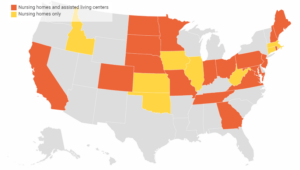
So far, 26 states are starting to allow nursing home visitation, while 18 others are planning similar visitation guidelines for assisted living facilities.

Nursing homes are allowing visitors; however, visitors will have to follow specific guidelines. These guidelines include:

  • Families must schedule an appointment to visit residents in advance
  • Visitors must undergo a temperature check and answer a COVID-19 screening questionnaire
  • Only 1 or 2 visitors can visit at a time
  • Visits must take place outside on a patio or garden area
  • No physical contact such as hugs are allowed
  • All visits will be supervised by a staff member
  • Visitors must practice social distancing by remaining 6 feet away from residents and staff

If a resident or staff member develops COVID-19, then the facility will ban all nursing home visitations. State officials may also implement a no-visitation policy if state officials note a significant rise in COVID-19 cases.

Understanding the Risks of Allowing Nursing Home Visitation

After nearly four months in isolation, many families feel relief knowing they can once again visit their loved ones. Between being isolated and COVID-19, the pandemic has taken a serious toll on the physical and mental health of residents nationwide. Residents have very limited interaction with other residents and staff and are confined to being in their rooms most of the time.

It’s important to understand that while this is step in the right direction, there’s also many risks to visiting your loved one in a nursing facility. Nursing home residents are the most vulnerable to contract COVID-19. Nearly 45 percent of COVID-19 deaths have occurred in long-term facilities.

Many families have expressed their concern over their loved one being neglected or abused during the lockdown. Without their involvement and oversight, families are worried their loved one has not received adequate care.

Learn More about Nursing Home Residents Rights

The COVID-19 pandemic has changed the way everything operates, especially nursing homes; however, nursing home residents still have rights. They have the right to quality care that ensures a safe and healthy life.

If you have concerns regarding the quality of care your loved one is receiving in a nursing home, please contact the experienced attorneys at the Dinizulu Law Group, Ltd. Our legal team will help you understand the rights of nursing home residents and ensure that your loved one gets the care he or she deserves. Even during a pandemic, we want you to know your loved one’s legal rights and know that you are not alone.

If you have any questions, please call our office at (312) 384-1920 for a free consultation or visit our website for more information.

Hyundai, Kia Agree to $758 Million Engine Fire Class Action Settlement

CHICAGO, IL – Hyundai and Kia have reached a $758 million settlement with car owners who claim that their vehicles suffer from premature engine failure which has caused cars to burst into flames. The class action lawsuits allege that the car companies were aware of the defect but did not disclose this information to customers. The settlement includes nearly 4.1 million car owners who bought a number affected vehicles.

According to the motion for approval of the class action settlement, the vehicles that are part of this Class include: “all 2011-2018 and certain 2019 model year Hyundai Sonata vehicles, all 2013-2018 and certain 2019 Hyundai Santa Fe Sport vehicles, all 2014-2015, 2018, and certain 2019 Hyundai Tucson vehicles, all 2011-2018 and certain 2019 Kia Optima vehicles, all 2011-2018 and certain 2019 Kia Sorento vehicles, and all 2011-2018 and 2019 Kia Sportage vehicles originally equipped with or replaced with a genuine Theta II 2.0 liter or 2.4 liter gasoline direct injection engine within OEM specifications.”

Due to defects highlight in the settlement agreement, Hyundai and Kia cars reportedly caught fire, resulting in personal injury claims such as property damage and/or physical injury. In extreme circumstances, the defects resulted in houses and/or garages being burned down.

Holding auto manufacturers liable for defective vehicles is never a simple task.  At the law office of the Dinizulu Law Group, Ltd., we take on tough cases against large corporations, and we know how to fight for your right as a consumer. Call (312) 384-1920 or contact us on our website for a free consultation with a Chicago personal injury attorney.

Sepsis Complications: How Nursing Homes Should Prevent & Treat

CHICAGO, IL – Infections are one of the leading causes of death in nursing homes throughout the country. Unfortunately, nursing homes can be inattentive to the conditions that give rise to infections and then leave the infections untreated, putting nursing home residents at risk.

An infection that is left untreated can turn into a very dangerous condition called sepsis. When someone develops septic shock, this is how an infection can kill. Sepsis happens when an infection you already have – in your skin, lungs, urinary tract, or somewhere else – triggers a chain reaction throughout your body. A toxic agent is introduced into the bloodstream because of the infection and will begin to result in organ failure. If you do not seek medical treatment in a timely manner, sepsis can rapidly lead to tissue damage, organ failure, and death.

There are numerous symptoms that may occur, with some of the more severe ones including:

  • Abnormal heart function including a very rapid heart rate
  • Significant pain and discomfort
  • Difficulty breathing
  • Disorientation or delirium
  • Unconsciousness

The Stages of Sepsis

Stage One: Systemic Inflammatory Response Syndrome (SIRS)

Sepsis can be difficult to identify but is typically denoted by a very high or low body temperature, high heart rate, high respiratory rate, high or low white blood cell count and a known or suspected infection. For sepsis, two of the mentioned SIR signs, as well as an infection, must be present.

Stage Two: Severe Sepsis

Severe sepsis is diagnosed when acute organ dysfunction begins. Severe sepsis can be diagnosed when sepsis is present along with hypotension, or low blood pressure, or hypoperfusion, the decreased blood flow through an organ.

Organ dysfunction can be characterized by symptoms such as a sudden change in mental state, decreased urine output, decreased blood platelet count, difficulty breathing, abnormal heart pumping function and abdominal pain.

Stage Three: Septic Shock

Septic shock is the most severe stage of sepsis. Septic shock is defined as the presence of hypotension, induced by sepsis, despite fluid resuscitation. Septic shock has the highest chance of mortality, with estimates that range from 30% to 50%.

Symptoms of Septic Shock

Septic shock is accompanied by the following symptoms:

  • Little to no urination
  • Blood clots throughout the body that can lead to organ failure
  • Very low or high temperature
  • Extremely low blood pressure
  • Palpitations

Even if the nursing home resident is about to survive septic shock, it will have long-term ramifications on their health and they likely will not make a full recovery.

Early detection of sepsis is necessary in order for a nursing home resident to have a better chance at survival; however, when a resident is a victim of nursing home neglect, they likely are not receiving the care that they need to notice the signs of sepsis and begin prompt treatment. This becomes more of a problem at understaffed nursing homes that are prone to neglect.

Medical Treatment for Patients with Sepsis

When a nursing home does diagnose and treat sepsis, the course of treatment begins with antibiotics. Some patients may need to have procedures to remove dead skin or tissue depending on the severity of the infection. Patients may also need oxygen or other intravenous fluids to maintain the level of oxygen and blood going to the organ so organ failure can be prevented. Patients can recover from mild sepsis in about three to ten days; however, more severe cases can take longer to recover if the patient is able to survive at all. Severe sepsis requires critical care for a month or more.

Sepsis and Pressure Ulcers

Sepsis is also how pressure ulcers can become fatal. There are four stages of a pressure ulcer: Stage I and II is the first discoloration of the skin and a small ulcer. Stage III is when a small crater in the skin begins to degenerate to a Stage IV pressure ulcer where the hole in the skin gets deeper and can reach the muscle. When the hole in the skin becomes large enough and is untreated, the resident can develop sepsis from the infection. A pressure ulcer can become septic, though the ones that are more advanced have a higher change of becoming infected. The wounds can leak puss and give off a foul smell. There can also be an increased in pain in the area and a fever.

Pressure ulcers should not form in the first place, but if they do, they should not reach the level of sepsis. If your loved one has developed sepsis, there is a high chance that the nursing home did not provide the level of care that it was legally obligated to, causing your family member to develop a life-threatening infection.

Nearly 25,000 residents in nursing homes will die from sepsis, and most of these deaths are preventable. Thousands of nursing homes each year are cited by the federal government for their failure to prevent and treat pressure ulcers.

Has Your Loved One Been Injured by a Nursing Home’s Failure to Treat an Infection? Get Legal Help Now

The experienced attorneys at the Dinizulu Law Group have handled numerous cases over the years where nursing home residents have died from infected pressure ulcers and other severe infections due to nursing home negligence. If your loved one has been injured or died from neglect at a nursing home, call us today at (312) 384-1920 to set up your free consultation. Please visit our website for additional information.

Translate »