Tag Archive for: Chicago IL lawyer

Posts

What Types of Evidence Is Used for Nursing Home Neglect and Abuse Cases?

CHICAGO, IL – More than 1.2 million people are living in nursing homes across the United States. Residents may live in a nursing home facility because they need help with daily tasks such as eating and bathing or may have long-term medical needs that families and other means cannot provide their loved one with. Many nursing home residents suffer from mental or physical disabilities that reduce their level of independence; therefore, nursing home staff must keep them as healthy and safe as possible.

Unfortunately, some nursing home residents are not treated with compassion and the competent medical attention they deserve. If you or your loved one has been a victim of abuse or neglect, you may want to bring a personal injury claim against the facilities and those who harmed you or a loved one. In order for your claim to be successful, you must show evidence of the nursing homes wrongdoing.

Elements of a Nursing Home Claim

To hold a negligent nursing home accountable and recover financial compensation for the abuse and/or neglect, you and your personal injury attorney will need to prove that:

  • The nursing home owed a duty to you or your loved one
  • The nursing home breached that duty
  • You or your loved one was injured as a result
  • The injuries resulted in damaged and/or financial costs

It can be hard to know exactly how a nursing home resident was injures – especially for those who suffer from a mental disability such as dementia or Alzheimer’s which affects their memory and cognition. To fully understand the circumstances, your personal injury attorney may gather evidence such as:

  • Care logs
  • Medical records and bills
  • Operating procedures, hiring practices, and staff training schedule
  • Surveillance footage
  • Photographs
  • Insurance claim documents
  • Testimony from witnesses
  • Testimony from “expert witnesses” such as medical professionals

Contact a Cook County Nursing Home Abuse Injury Attorney

Nursing homes have both an ethical and legal obligation to provide residents with the adequate everyday care and medical attention they need; however, sometimes they fall short. If a nursing home caused a resident to be injured due to their negligence or being intentionally abusive, the injured person may file a personal injury claim. To learn more about bringing a nursing home injury lawsuit against a negligent facility, contact the Dinizulu Law Group at (312) 384-1920 to schedule a free consultation with an experienced Chicago personal injury attorney. Visit our website for more information.

Some States Begin to Allow Nursing Home Visitation

CHICAGO, IL – For millions of American families, the COVID-19 pandemic has restricted families from visiting their loved ones in nursing homes and assisted living centers. Now, as many states begin to roll back strict policies initially put in place when the pandemic began, some families finally have the opportunity to see their loved ones in person.

With new guidance from the Centers for Medicare and Medicaid Services (CMS) and the Centers for Disease Control and Prevention (CDC), nursing homes are allowed to use more creative measures to allow visits from family members.

What States Allow Nursing Home Visitation?

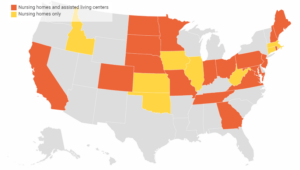
So far, 26 states are starting to allow nursing home visitation, while 18 others are planning similar visitation guidelines for assisted living facilities.

Nursing homes are allowing visitors; however, visitors will have to follow specific guidelines. These guidelines include:

  • Families must schedule an appointment to visit residents in advance
  • Visitors must undergo a temperature check and answer a COVID-19 screening questionnaire
  • Only 1 or 2 visitors can visit at a time
  • Visits must take place outside on a patio or garden area
  • No physical contact such as hugs are allowed
  • All visits will be supervised by a staff member
  • Visitors must practice social distancing by remaining 6 feet away from residents and staff

If a resident or staff member develops COVID-19, then the facility will ban all nursing home visitations. State officials may also implement a no-visitation policy if state officials note a significant rise in COVID-19 cases.

Understanding the Risks of Allowing Nursing Home Visitation

After nearly four months in isolation, many families feel relief knowing they can once again visit their loved ones. Between being isolated and COVID-19, the pandemic has taken a serious toll on the physical and mental health of residents nationwide. Residents have very limited interaction with other residents and staff and are confined to being in their rooms most of the time.

It’s important to understand that while this is step in the right direction, there’s also many risks to visiting your loved one in a nursing facility. Nursing home residents are the most vulnerable to contract COVID-19. Nearly 45 percent of COVID-19 deaths have occurred in long-term facilities.

Many families have expressed their concern over their loved one being neglected or abused during the lockdown. Without their involvement and oversight, families are worried their loved one has not received adequate care.

Learn More about Nursing Home Residents Rights

The COVID-19 pandemic has changed the way everything operates, especially nursing homes; however, nursing home residents still have rights. They have the right to quality care that ensures a safe and healthy life.

If you have concerns regarding the quality of care your loved one is receiving in a nursing home, please contact the experienced attorneys at the Dinizulu Law Group, Ltd. Our legal team will help you understand the rights of nursing home residents and ensure that your loved one gets the care he or she deserves. Even during a pandemic, we want you to know your loved one’s legal rights and know that you are not alone.

If you have any questions, please call our office at (312) 384-1920 for a free consultation or visit our website for more information.

Sepsis Complications: How Nursing Homes Should Prevent & Treat

CHICAGO, IL – Infections are one of the leading causes of death in nursing homes throughout the country. Unfortunately, nursing homes can be inattentive to the conditions that give rise to infections and then leave the infections untreated, putting nursing home residents at risk.

An infection that is left untreated can turn into a very dangerous condition called sepsis. When someone develops septic shock, this is how an infection can kill. Sepsis happens when an infection you already have – in your skin, lungs, urinary tract, or somewhere else – triggers a chain reaction throughout your body. A toxic agent is introduced into the bloodstream because of the infection and will begin to result in organ failure. If you do not seek medical treatment in a timely manner, sepsis can rapidly lead to tissue damage, organ failure, and death.

There are numerous symptoms that may occur, with some of the more severe ones including:

  • Abnormal heart function including a very rapid heart rate
  • Significant pain and discomfort
  • Difficulty breathing
  • Disorientation or delirium
  • Unconsciousness

The Stages of Sepsis

Stage One: Systemic Inflammatory Response Syndrome (SIRS)

Sepsis can be difficult to identify but is typically denoted by a very high or low body temperature, high heart rate, high respiratory rate, high or low white blood cell count and a known or suspected infection. For sepsis, two of the mentioned SIR signs, as well as an infection, must be present.

Stage Two: Severe Sepsis

Severe sepsis is diagnosed when acute organ dysfunction begins. Severe sepsis can be diagnosed when sepsis is present along with hypotension, or low blood pressure, or hypoperfusion, the decreased blood flow through an organ.

Organ dysfunction can be characterized by symptoms such as a sudden change in mental state, decreased urine output, decreased blood platelet count, difficulty breathing, abnormal heart pumping function and abdominal pain.

Stage Three: Septic Shock

Septic shock is the most severe stage of sepsis. Septic shock is defined as the presence of hypotension, induced by sepsis, despite fluid resuscitation. Septic shock has the highest chance of mortality, with estimates that range from 30% to 50%.

Symptoms of Septic Shock

Septic shock is accompanied by the following symptoms:

  • Little to no urination
  • Blood clots throughout the body that can lead to organ failure
  • Very low or high temperature
  • Extremely low blood pressure
  • Palpitations

Even if the nursing home resident is about to survive septic shock, it will have long-term ramifications on their health and they likely will not make a full recovery.

Early detection of sepsis is necessary in order for a nursing home resident to have a better chance at survival; however, when a resident is a victim of nursing home neglect, they likely are not receiving the care that they need to notice the signs of sepsis and begin prompt treatment. This becomes more of a problem at understaffed nursing homes that are prone to neglect.

Medical Treatment for Patients with Sepsis

When a nursing home does diagnose and treat sepsis, the course of treatment begins with antibiotics. Some patients may need to have procedures to remove dead skin or tissue depending on the severity of the infection. Patients may also need oxygen or other intravenous fluids to maintain the level of oxygen and blood going to the organ so organ failure can be prevented. Patients can recover from mild sepsis in about three to ten days; however, more severe cases can take longer to recover if the patient is able to survive at all. Severe sepsis requires critical care for a month or more.

Sepsis and Pressure Ulcers

Sepsis is also how pressure ulcers can become fatal. There are four stages of a pressure ulcer: Stage I and II is the first discoloration of the skin and a small ulcer. Stage III is when a small crater in the skin begins to degenerate to a Stage IV pressure ulcer where the hole in the skin gets deeper and can reach the muscle. When the hole in the skin becomes large enough and is untreated, the resident can develop sepsis from the infection. A pressure ulcer can become septic, though the ones that are more advanced have a higher change of becoming infected. The wounds can leak puss and give off a foul smell. There can also be an increased in pain in the area and a fever.

Pressure ulcers should not form in the first place, but if they do, they should not reach the level of sepsis. If your loved one has developed sepsis, there is a high chance that the nursing home did not provide the level of care that it was legally obligated to, causing your family member to develop a life-threatening infection.

Nearly 25,000 residents in nursing homes will die from sepsis, and most of these deaths are preventable. Thousands of nursing homes each year are cited by the federal government for their failure to prevent and treat pressure ulcers.

Has Your Loved One Been Injured by a Nursing Home’s Failure to Treat an Infection? Get Legal Help Now

The experienced attorneys at the Dinizulu Law Group have handled numerous cases over the years where nursing home residents have died from infected pressure ulcers and other severe infections due to nursing home negligence. If your loved one has been injured or died from neglect at a nursing home, call us today at (312) 384-1920 to set up your free consultation. Please visit our website for additional information.

Ahmaud Arbery: Witness Says Before Shooting the McMichaels Hit Him with Their Car

CHICAGO, IL – The three white men who are accused of killing Ahmaud Arbery faced a Glynn County judge Thursday morning for their preliminary and bond hearings. Arbery, an unarmed black man, was being pursued by Travis and Gregory McMichael, two white man, when he was gunned down while jogging on February 23 near Brunswick, Georgia.

A 28-second cell phone video of Arbery being shot and killed flooded social media platforms months later and the public called for the McMichaels to be arrested. On May 5, officials with the Georgia Bureau of Investigations secured search warrants to arrest the McMichaels on murder and aggravated assault charges. On May 21, the man who filmed the killing, William “Roddie” Bryan, was arrested on felony murder charges.

The three men engaged in an elaborate chase, hitting the 25-year-old jogger with a truck as he tried to escape them. Richard Dial, GBI Assistant Special Agent in Charge, was asked whether he believed McMichael could’ve been acting in self-defense, he said it was Arbery who was defending himself.

“I believe Mr. Arbery was being pursued, and he ran until he couldn’t run anymore, and it was he turned his back to a man with a shotgun or fight with his bare hands against the man with the shotgun. He chose to fight,” Dial said according to CNN. “I believe Mr. Arbery’s decision was to just try to get away, and when he felt like he could not escape he chose to fight.”

As Travis and Gregory McMichael attempted to head him off, Arbery then turned and ran past the truck of Bryan who struck Arbery with the side of his truck. Investigators found a swipe from a palm print on the rear door of Bryan’s truck, cotton fibers near the truck bed that are attributed to contact with Arbery, and a dent below the fibers.

Arbery’s last moments emerged amid a week of nationwide protests over another killing – of George Floyd by police in Minneapolis – and demonstrators have called for justice in Arbery’s case.

Dial also testified that there were numerous times on social media that McMichael used the same slur words to describe people of color. Dial did not say which McMichael he was referring to and was not asked to clarify.

The Justice Department has launched a hate crime investigation in this case. With tensions already running high in Brunswick and the rest of the country, Georgia Governor Brian Kemp said the state will do “whatever is necessary to keep the peace.”

Semi-Truck Explodes on I-94 Killing 2 in Racine County

CHICAGO, IL – Just before 11 am on Wednesday morning, two semi-truck drivers were killed in a multi-vehicle car crash on I-94 in Racine County, Wisconsin.

Northbound and southbound lanes were closed throughout the day and into Thursday afternoon, though southbound lanes reopened around 8:30 p.m.

According to ABC 7 Chicago, a semi-truck driver was driving southbound attempting to switch lanes when it over-corrected and lost control before hitting the median wall of the interstate, bursting into flames. As a result of the collision, three other vehicles collided into each other and the median wall.

Another semi-truck traveling northbound attempted to avoid the crash by turning into a ditch lane, in which he drove off the road, and burst into flames. The truck plunged nearly 30 feet off the right side of the highway, onto another road. The semi-trailer caught fire before exploding.

Two semi-truck drivers died at the scene, and at least two others were taken to a local hospital and sustained minor injuries.

Semi-truck accidents or collisions can be rare, but when they occur, they can be catastrophic. The average weight of a commercial vehicle is roughly 80,000-230,000 pounds. Semi-trucks also require a longer distance to stop. If a semi is driving 55 miles per hour, it will take about 400 feet to come to a complete stop (Safer America, 2019). Please keep these thoughts in mind when passing in a semi-drivers blind spot or driving past any commercial truck.

Translate »