Tag Archive for: Chicago

Posts

Ceiling fans sold at Home Depot recalled because blades may spin off

CHICAGO, IL – More than 190,000 ceiling fans have been recalled because of the fans’ blades may detach and fly off while in use.

King of Fans, a Fort Lauderdale-based company that makes the 54-inch Mara ceiling fans, announced the recall on Wednesday after receiving 47 reports of blades detaching, with at least two consumers hit by a blade and four instances of property damage.

The fans were sold in Home Depot nationwide from April to October of this year costing nearly $150. About 182,000 were sold in the U.S. and another 8,800 were sold in Canada.

The recall came in three finishes according to U.S. Consumer Product Safety Commission:

  • Matte white (UPC No. 082392519186)
  • Matte black (UPC No. 082392519193)
  • Black (UPC No. 082392599195)
  • Polished nickel (UPC No. 082392599188)

Consumers have been urged to stop using the fans immediately and to check for signs of defects. For those who notice “blade movement or uneven gaps between the blades and fan body,” should contact King of Fans for a free replacement.

King of Fans can be contacted at (866) 433-1291, Monday through Friday from 9 a.m. to 5 p.m. EST, or by emailing MaraRecall@KingofFans.com.

National Safety Council Estimates More Than 720 Fatalities in Roadway Crashes over Christmas, New Year’s Holiday

CHICAGO, IL – While the holiday season may look a bit different this year, there’s one thing that remains stagnant: holiday traffic fatalities. While the CDC urges Americans against traveling, many will still be on the go.

The National Safety Council (NSC), located in Itasca, Ill.) estimates more than 720 people will be killed on the roadway during Christmas weekend across the nation, and an additional 384 over New Year’s weekend.

As many as 287 lives could be saved over both holiday periods if all vehicle occupants wore their seatbelts, according to NSC. Parents and guardians should be advised to check a child’s car seat is properly installed.

Please do not get behind the wheel if you have been drinking. By drinking intoxicated, you run the risk of harming yourself and other innocent bystanders. Alcohol is involved in nearly 39% of traffic fatalities over Christmas and New Year’s holiday periods. Technology has made everything so accessible now – choose alternative methods of transportation such as a ride-share like Uber or Lyft, cab, Metra, CTA, or el.

Other recommendations by NSC include:

  • Avoid distracted driving, including hands-free cellphone usage.
  • Get plenty of sleep and take regular breaks to avoid fatigue.
  • Be aware of how others are driving on the road and maintain a safe distance.
  • Sign a “New Driver Deal” with teen drivers at DriveItHOME.org.
  • Learn about your vehicle’s safety systems and how to use them at MyCarDoesWhat.org.
  • Check your vehicle for any recalls before getting on the road at ChecktoProtect.org.

“A safe travel season could instill much-needed hope as we start a new year and close an unrelenting one,” NSC President and CEO Lorraine M. Martin stated in a press release. “We can all do our part by buckling up, driving sober, slowing down, and avoiding distractions to look out for each other.”

Body Camera Footage Shows Moments Police Handcuff Innocent Woman During Wrong Raid

CHICAGO, IL – Police body camera footage was released on Tuesday and shows what happened to an innocent woman nearly two years ago when police officers wrongly entered her home with guns drawn and handcuffed her naked while she watched the horrific scene unfold.

Anjanette Young filed a Freedom of Information Act (FOIA) request last year and recently obtained the footage after a court ordered the Chicago Police Department to turn it over as part of her lawsuit against police, according to CBS Chicago.

The video shows on Feb. 21, 2019, nine body cameras caught a group of male officers entering Young’s home at 7 p.m. Young had just finished her shift as a licensed social worker at a hospital and was undressing in her bedroom when she heard a loud, pounding noise.

Officers repeatedly struck her door with a battering ram. From various angles of the footage, the video captured the moment officers broke her door down.

Young remembers officers yelling, “Police! Search warrant,” and “Hands up.” Moments later, Young is seen naked in the living room with her hands up. An officer can be seen eventually handcuffing her.

“What is going on?” Young yells in the video. “There’s nobody else here, I live alone. You’ve got the wrong house.”

An officer found a blanket and wrapped it around Young as she cried asking officers who they were looking for. The blanket began to slide off and expose her body in which no officer made an attempt to cover her.

Young can be heard telling police at least 43 times they were in the wrong home. She asked police to allow her to get dressed and informed them they had the wrong information.

“Oh my god, this cannot be right. How is this legal?” Young said during the raid.

According to CPD’s complaint for a search warrant, a confidential informant told the lead officer of the raid that he recently saw a 23-year-old man who was a known felon with a gun and ammunition.

The officer found a photo of the suspect in a police database and showed it to the informant, who then confirmed that was him. The officer drove the informant to the address where the informant claimed the suspect lived.

Despite police making no effort to independently verify the informant’s tip, such as conducting surveillance or any other policy checks, the search warrant was approved by an assistant state’s attorney and judge.

The informant gave police the wrong address; the suspect police were looking for lived in the unit next door to Young’s and had no connection to her.

Body camera footage also raises questions about the approval of the warrant. In one clip, officers can be heard talking saying the warrant was not initially approved.

“What does that mean?” the second officer asked.

“I have no idea,” the first officer said. “They said it was approved, then I guess that person messed up on their end.”

This is not the first time police have failed to do basic routine checks regarding bad information given by an informant.

Young said the way officers treated and spoke to her during the raid caused her experience to be more traumatic. You can see in the footage she’s visibly upset pleading with officers to tell her what was going on.

The sergeant asked Young if there were any firearms in her home.

“There’s no guns in here,” she said. “I’ve been a social worker for 20 years. I follow the lwa. I don’t get in trouble for anything. I don’t do illegal stuff. I’m not that person. You have the wrong information.”

The sergeant told the affiant officer – the officer who received the warrant – to step outside.

“I want to have a conversation with you,” the sergeant said.

Moments later, the officer’s body camera turned off.

After nearly 20 minutes, police remove the handcuffs. Towards the end of the raid, the sergeant apologized to Young.

“I apologize for bothering you tonight,” the sergeant tells Young. “I assure you the city will be in contact with you tomorrow. I apologize for meeting you this way. I will do everything I can to get the door fixed.”

Young said it was “surreal” to watch the footage back two years later. She continues to live with trauma and leans on church and her faith for support. She believes she has a responsibility to use her voice to protect others from being in the same situation.

Nursing home workers reach tentative deal to end strike against Infinity

CHICAGO, IL – A tentative agreement between Infinity Healthcare Management and its nursing home workers was reached on Friday after nearly 700 employees went on strike nearly two weeks ago.

Hundreds of workers at 11 Illinois locations of Infinity Health Care Management nursing homes went on strike on Nov. 23. Nine of those nursing homes are in the Chicago area.

Nursing home workers include cooks, housekeepers, and certified nursing assistants. Employees have been negotiating a new contact since June, immediately following when their last contract was expired.

SEIU Healthcare Illinois previously said the company discontinued pandemic pay – higher wages for essential workers during the coronavirus pandemic – at the end of July, despite receiving $12.7 million in funding from the federal CARES Act.

Under a new three-year contract, all workers would receive a minimum $1 an hour raise, with the average staff member receiving a $2 an hour wage increase. Workers would also earn annual raises in year two and three of the contract, according to SEIU Healthcare Illinois union leaders.

Nursing home workers in facilities with verified coronavirus cases or facilities being monitored due to COVID-19 cases, will also receive an increase in pandemic pay, from $2 an hour to $2.50 an hour. Employees will also gain five days of COVID-19 related sick time and be guaranteed adequate personal protective equipment.

Chicago Sun Times reported union leaders said under the new proposed contract, the average hourly wage will jump from $13.65 to $15.58. The union states the agreement will raise standards for Certified Nursing Assistant pay, which in turn, will help improve staffing levels and the level of resident care.

How Are Nursing Homes Different than Assisted Living Facilities?

CHICAGO, IL – Many people often mistake nursing homes with living assisted facilities; however, the two offer two different levels of care. Assisted living facilities often provide personal care in a home-like, social setting and is generally for people who need extra monitoring or help. On the other hand, nursing homes are for people who are seriously ill and require around the clock care and monitoring.

According to the law in Illinois, assisted living facilities are described as “a home, building, or residence, or any place where sleeping accommodations are provided for at least three unrelated adults, in which at least 80% are 55 years of age or older, where the following is provided: services based on a social media where the resident’s unit is their home, mandatory services such as meals and laundry, and a physical environment that is a homelike setting,” (77 ILCS 295.200).

Long-term care facilities, like a nursing home, have a much higher level of care than a senior living home and different requirements under the law. According to Illinois law, a long-term care facility is “a private home, institution, building, or residence, or any other place, whether operated for profit or not, or a county home for the infirm and chronically ill,” (210 ILCS 45/1-113).

Care and Services Provided in Senior Housing

Assisted living facilities are generally for people who need help with activities of daily living. Assisted living is a more independent level of living. Someone who suffers from memory loss and who isn’t safe living alone is someone who would live in assisted living.

By contrast, residents in nursing homes require around the clock care and monitoring. Residents in nursing homes offer suffer with more complex health care conditions that require additional assistance of a skilled nurse or a physical or speech therapist. Nursing homes legal purpose is to provide residents with intensive health care and nursing care to people who suffer from chronic conditions, like dementia or Alzheimer’s.

Regulatory Differences Between a Nursing Home and Assisted Living in Illinois

Nursing homes in Illinois are licensed, regulated, and inspected and/or certified by a number of public and private agencies, including the Illinois Department of Public Health (IDPH) and the U.S. Department of Health and Human Services Centers for Medicare and Medicaid (CMS). The IDPH is responsible for ensuring all nursing homes in the state comply with mandatory state regulations. IDPH also ensures facilities accept Medicare and Medicaid payment for services rendered to program beneficiaries meet all federal regulations.

Nursing homes are inspected at least once every six to 15 months, according to IDPH. Nursing home inspections, whether standard or in response to a complaint, are conducted without giving notice to the facility.

Assisted living facilities are often loosely regulated. Regulations are set by individual state laws, which is different in every state, and are not monitored by state or local governments. Assisted living facilities also do not receive Medicare or Medicaid funding. Illinois’ state regulation of assisted living facilities include is they must be licensed by the Division of Assisted Living.

Though there are some differences in nursing homes and assisted living facilities, there are many obvious differences. Before deciding where to place your loved one, make sure to research both facilities before determining which is a right fit.

F.A.A. Clears Boeing 737 Max to Fly Again

CHICAGO, IL – After 20 months on the ground, Boeing’s 737 Max will soon begin to fly after it tragically cost 346 people their lives.

The Max was grounded worldwide in March 2019 when the FAA jointed regulators in dozens of other countries banning the plane after the two fatal crashes in Indonesia and Ethiopia.

The Federal Aviation Administration (FAA) gave clearance to the 737 Max’s to fly once again after changes were made to the design, software and additional crew training would eliminate flaws that caused the fatal crashes in 2018 and 2019.

Boeing is facing billions of dollars in losses due to the grounding and has been affected by the blow to the aviation industry due to the coronavirus pandemic. According to The New York Times, Boeing is the largest manufacturing exporter in the United States, one of the federal government’s biggest contractors, a blue chip stock and a major employer whose fortunes help shape the national economy.

Boeing expects to begin 2021 with a global work force of 130,000 down nearly 19 percent from the head count at the beginning of this year.

The Max is the latest in Boeing’s 737 line. There are more than 380 Max planes in the global fleet, according to Cirium, an aviation data firm.

After the two deadly crashes last year, investigators have attributed the crashes to a range of problems including engineering flaws, mismanagement, and a lack of regulatory oversight. Much of the investigation was focused on a software known as MCAS, which was designed to push the plane’s nose down in certain situations.

At a news conference on Tuesday, relatives of victims from Ethiopian Airlines Flight 302 questioned whether Boeing had done enough to address safety concerns.

The changes ordered by the FAA include updated MCAS to avoid erroneous activation, updating display software to alert pilots when data from sensors are conflicting, rerouting internal wiring and updating flight manuals.

Even in the United States, it could be months before the Max begins to transport passengers again. The FAA must approve pilot training procedures for each U.S. airline operating the Max and planes must be updated; however, airlines suffering from a huge decline in traffic during the pandemic may feel more urgency to act quickly.

American Airlines is expected to the first U.S. carrier to fly the Max, with plans to fly the plane from Dec. 29 to Jan 4 for flights connecting Miami with La Guardia Airport in New York.

United Airlines said it expects to fly the Max during the first quarter of next year after 1,000 hours of work on every plane and “meticulous technical analysis.” Southwest Airlines said they didn’t expect to resume flights until the second quarter.

In both crashes, faulty sensors activated the software sending the planes toward the ground as the pilots struggled to pull them back up.

On Tuesday, the House passed a bipartisan bill aimed at changing FAA certification procedures. It will also require an expert panel to review Boeing’s safety culture. The Air Line Pilots Association applauded the legislation saying that there were “much-needed” changes to the certification process.

Woman dies weeks after Scottsdale crash

A Chicago woman passed away on Monday from blunt force injuries she sustained in a car crash last month in Scottsdale on the Southwest Side.

On June 25, she was driving her 2019 Toyota Rav 4 around 9 p.m. on South Pulaski Road when a man driving a Chevy Silverado at a high speed of rate struck her vehicle.

According to Chicago Sun Times, the 28-year-old man who was driving the Chevy said he was being followed and was traveling around 75 mph, according to police. He was issued citations for failure to reduce speed, driving an uninsured vehicle, and causing bodily harm.

Medical Malpractice: Claim Requirements and How to Prove a Claim

CHICAGO, IL – Medical malpractice occurs when a patient is harmed by a medical professional, or doctor, who fails to competently perform his/her medical duties. State rules about medical malpractice differ in terms of how long you have to bring forth your lawsuit to notifying your doctor of a lawsuit; however, there are some general requirements to file a malpractice claim.

Basic Requirements for a Medical Malpractice Claim

To prove that medical malpractice occurred, you must be able to prove the following:

  1. A doctor-patient relationship existed. You must show that you and your doctor established a doctor-patient relationship – this means, you hired the doctor and the doctor agreed to have you as a patient. If a doctor began to see you and treat you as a patient, it’s relatively easy to prove a physician-patient relationship existed.
  2. The doctor was negligent. The doctor must have been negligent when diagnosing you or in your treatment. To sue for malpractice, you have to prove that your doctor harmed you in a way that a competent doctor, under the same circumstances, would not have. It’s important to note that the doctor’s care is not required to be the best possible, but rather “reasonably skillful and careful.” Nearly every state requires the patient presents a medical expert to discuss the appropriate standard of care and show how the doctor deviated from the standard of care.
  3. The doctor’s negligence caused the injury. Because many malpractice cases involve patients that were already sick or injured, the question that often arises is whether what the doctor did, negligent or not, actually caused the patient harm. A patient must show that it was more likely than not that the doctor’s incompetence directly caused their injury. Normally, the patient must have a medical expert testify that the doctor’s negligence directly caused further harm.
  4. The injury led to specific damages. Even if it’s clear that your doctor performed below the standard of care, the patient cannot sue a doctor if they didn’t suffer any harm. Some examples of the types of harm patients can sue for are:
    • Physical pain
    • Mental anguish
    • Additional medical bills
    • Lost work and lost earnings

Common Types of Medical Malpractice

There is a wide variety of situations that can lead to a medical malpractice claim; however, most malpractice claims fall into one of these categories:

  • Improper treatment. If a doctor fails to follow the standard of care and treats the patient in a way that no other doctor would, the patient could have a medical malpractice claim. It could also be a malpractice claim if the doctor were to select the appropriate treatment, but administers it incompletely.
  • Failure to diagnose. If a competent doctor would have discovered the patient’s illness or made a different diagnosis, which could have led to a better outcome, the patient may have a medical malpractice claim.
  • Failure to warn a patient of known risks. Doctors are responsible for warning patients of known risks of a procedures or a course of treatment, known as the duty of informed consent. If a patient, once properly informed of all possible risks, would have elected not to go through with the procedure, the doctor may be held liable for hurting their patient if they were injured by the procedure.

Statute of Limitations

The statute of limitations is a strict amount of time you have to get your case started in the state’s civil court system; however, this differs from state to state. Illinois has a statute of limitations that directly applies to medical malpractice cases. That law requires the lawsuits to be filed within two years of the date in which the plaintiff knew, or should’ve known, about the injury that was caused by the healthcare professional’s malpractice.

In the event that this is not discovered right away, the Illinois medical malpractice statute of limitations goes on to set a larger deadline in which a malpractice claim can be brought more than four years after the date the medical error occurred. You can learn more about this here.

If the plaintiff is under the age of 18, there is a specific filing deadline for a lawsuit filed on behalf of them. These cases must be filed within eight years of the date on which the malpractice occurred, but in no event can the case be brought beyond the person’s twenty-second birthday.

Getting Help

Medical malpractice law is highly complex that differs from state to state, so it’s important to get advice or representation by a lawyer.

The medical malpractice attorneys at the Dinizulu Law Group are highly experienced and have the resources to properly handle your medical malpractice claim. If you have been harmed or suffered an injury due to your healthcare providers negligence, please contact our office at (312) 384-1920 for a free consultation.

What Are a Nursing Home Resident’s Financial Rights?

When you think of a nursing home, you probably imagine many elderly individuals living there who rely on staff members to help them with their everyday tasks. While it is true that most do require around the clock assistance, there are plenty of residents who still act independently and are able to manage certain areas of their life. Take finances, for instance. A large portion of residents living in a nursing home in Illinois still have the mental capacity to make financial decisions and even handle their own money. According to The Consumer Voice, some of the financial rights a nursing home resident has include:

  • They have the right to handle their own bank accounts and money.
  • They have access to their funds on weekdays during business hours.
  • They are able to withdraw as much of their own money as they choose.
  • They can keep their spending habits private.
  • They can receive an itemized account of their monthly bill.
  • They can appoint a person to handle their finances.

Because a nursing home resident may still have access to their funds, many individuals, including workers and even family members, will sometimes take advantage of their vulnerability and steal from them. This is referred to as financial abuse or financial exploitation. Because this is a serious issue many aging individuals are faced with today, it is important that if you are considering allowing someone to manage your money, it is someone you can trust.

What are some preventative measures that can be taken to avoid theft in a nursing home?

Aside from financial abuse, nursing home residents also find themselves faced with other issues including having their valuable items taken from them should they choose to bring them when they transition from living in their own home and into a nursing home. Because we understand how important these items may be as they may not only hold value but also a place in your heart, it is important that you take preventative measures to avoid from becoming a victim of theft during your stay. Some preventative measures The Consumer Voice recommends you take include:

  • Mark all of your personal items, including watches, dentures, eyeglasses, and hearing aids, etc. so that everyone knows who they belong to.
  • Keep a written inventory checklist of clothing and other valuables, signed by you and a representative from the facility.
  • Provide your family members with a copy of the inventory checklist as well.
  • Take pictures of your valuable items.
  • Keep copies of all receipts for any items taken into the facility.
  • Place locks on clothing drawers and/or cabinets, where only you and an administrator have a key to open it.

What should I do if I am the victim of financial abuse?

If you or your aging relative has become the victim of financial abuse and you believe an Illinois nursing home employee is inflicting this abuse, you are encouraged to contact the Chicago, IL nursing home abuse lawyers at Dinizulu Law Group, Ltd. Our dedicated team of attorneys can investigate into the matter and gather all the necessary evidence that proves you or your loved one is, in fact, the victim of such abuse. We can then explain what options are available in terms of taking legal action and help you make an informed decision as to which may be the best for you to pursue.

To schedule a consultation to learn more about nursing home financial abuse and how we can serve as an advocate for you and your loved one, contact us today at (312) 384-1920.

Some States Begin to Allow Nursing Home Visitation

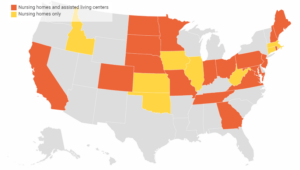
CHICAGO, IL – For millions of American families, the COVID-19 pandemic has restricted families from visiting their loved ones in nursing homes and assisted living centers. Now, as many states begin to roll back strict policies initially put in place when the pandemic began, some families finally have the opportunity to see their loved ones in person.

With new guidance from the Centers for Medicare and Medicaid Services (CMS) and the Centers for Disease Control and Prevention (CDC), nursing homes are allowed to use more creative measures to allow visits from family members.

What States Allow Nursing Home Visitation?

So far, 26 states are starting to allow nursing home visitation, while 18 others are planning similar visitation guidelines for assisted living facilities.

Nursing homes are allowing visitors; however, visitors will have to follow specific guidelines. These guidelines include:

  • Families must schedule an appointment to visit residents in advance
  • Visitors must undergo a temperature check and answer a COVID-19 screening questionnaire
  • Only 1 or 2 visitors can visit at a time
  • Visits must take place outside on a patio or garden area
  • No physical contact such as hugs are allowed
  • All visits will be supervised by a staff member
  • Visitors must practice social distancing by remaining 6 feet away from residents and staff

If a resident or staff member develops COVID-19, then the facility will ban all nursing home visitations. State officials may also implement a no-visitation policy if state officials note a significant rise in COVID-19 cases.

Understanding the Risks of Allowing Nursing Home Visitation

After nearly four months in isolation, many families feel relief knowing they can once again visit their loved ones. Between being isolated and COVID-19, the pandemic has taken a serious toll on the physical and mental health of residents nationwide. Residents have very limited interaction with other residents and staff and are confined to being in their rooms most of the time.

It’s important to understand that while this is step in the right direction, there’s also many risks to visiting your loved one in a nursing facility. Nursing home residents are the most vulnerable to contract COVID-19. Nearly 45 percent of COVID-19 deaths have occurred in long-term facilities.

Many families have expressed their concern over their loved one being neglected or abused during the lockdown. Without their involvement and oversight, families are worried their loved one has not received adequate care.

Learn More about Nursing Home Residents Rights

The COVID-19 pandemic has changed the way everything operates, especially nursing homes; however, nursing home residents still have rights. They have the right to quality care that ensures a safe and healthy life.

If you have concerns regarding the quality of care your loved one is receiving in a nursing home, please contact the experienced attorneys at the Dinizulu Law Group, Ltd. Our legal team will help you understand the rights of nursing home residents and ensure that your loved one gets the care he or she deserves. Even during a pandemic, we want you to know your loved one’s legal rights and know that you are not alone.

If you have any questions, please call our office at (312) 384-1920 for a free consultation or visit our website for more information.

Translate »