Tag Archive for: Truck Accident

Posts

Intoxicated Motorcyclist Hospitalized After Slamming into Semi Truck on Rte. 59

Accidents are happening all around us. During the early morning hours and even late at night, drivers are getting involved in preventable accidents that result in them suffering from life-threatening injuries that have the potential to affect them for weeks, months, and even years. But, with drivers engaging in behavior that is both distracting and dangerous, we can only expect to see the number of roadway accidents continue to rise, that is unless drivers begin implementing safety measures that will help keep them safe and avoid an accident. Read more

Who is Responsible for a Truck Accident?


If you were hit by a truck on the road, you might simply think that it was the truck driver who lost control and hit you and your vehicle. But the cause of your accident may be more complex and there may be much to uncover. Watch the video to learn more.

When a truck crash happens, a knowledgeable truck accident attorney will examine the many factors involved that resulted in the injury to you. The right attorney will ask you and the other parties certain questions to make sure that no stone is left unturned.

The proper attorney may involve the truck driver: Remember, the truck driver may have made an individual driving decision that was dangerous. Your injury could have been caused by distracted driving or speeding by the truck driver.

The attorney may involve the trucking company. The company who owns the truck and employs or contracts a driver must have proper hiring and training protocols in place. An attorney may uncover gaps in the truck company’s hiring and/or training practices, or may find that a trucking company is pressuring its drivers to work beyond their regulated hours. The attorney is also able to uncover whether a company is properly inspecting and maintaining its trucks.

Suppose the truck driver and trucking company did everything they could to ensure safety of those on the roadways. The crash could still have been caused by faulty parts. Defects in manufacturing or maintenance of brakes or chassis pins can sometimes be detected during a driver’s pre-truck inspection, but that’s not always the case. In that case, your attorney may involve the entities responsible for manufacturing the truck or its parts, or those responsible for maintaining the truck in your suit.

Furthermore, cargo companies are often responsible for securing a truck load. If an accident happens due to shifting cargo, your attorney can investigate if the cargo was secured based on industry practices.

To get to the root cause of your accident injury, your attorney must fully understand all the tools that are at his or her disposal during a case investigation. A knowledgeable and experienced attorney will be able to identify all the causes leading to your injuries.  Your full recovery is easier to accomplish when you are using attorneys who fully understand all the steps of litigation and arbitration.

At the Dinizulu Law Group, Ltd. our trucking accident trial attorneys have over 50 years of combined experience that we put to test every day. Call us at 1 (312) 384-1920 or 1 (800) 693-1LAW with your questions and concerns, or reach us by email. Our verdicts and settlements have helped many clients facing an uncertain time in their lives arrive at a place of relief and stability.

Truck Accidents Caused by Careless Inspections


The law requires trailer and truck drivers to conduct a pre-trip inspection before the start of their route and once every 24 hours while on the road. It is the truck driver’s responsibility to ensure the vehicle they are expected to drive is safe for operation and free from defects. During a pre-trip inspection, the truck driver checks the vehicle’s mechanics, such as brakes, lights, tires, etc. to determine if they are functioning properly. The trucker must also ensure that the load being driven is securely loaded into place. The load must also be at or under the maximum weight capacity that is appropriate for that particular truck.

The driver of a truck should get behind the wheel only after ensuring that the pre-trip inspection trip didn’t reveal any problems with the truck’s operational capabilities and that the truck load is secure. A thorough pre-trip inspection should last between 30 to 50 minutes. While there is no established regulation that addresses the time frame to be allotted for truck and trailer inspection, 30 to 50 minutes is the expected time it takes to complete a thorough inspection. Every truck driver is taught to perform a pre-trip inspection as part of their CDL training, and they must know how to do one properly in order to get a CDL license.

Commercial trailer truck accident

Often times, truck accidents happen because a truck driver missed something during a pre-trip inspection. Truck accidents caused by falling debris from a cargo load are pretty common. Such accidents can be prevented if truck drivers are simply given enough time and support from the trucking industry to perform these life-saving inspections.

But many truck companies ignore safety rules and take shortcuts to protect their bottom lines. Examples include truck drivers not getting paid for the time they spend on inspections, even though it’s part of their required day. As a result, it’s not uncommon to hear of inspections that last only 10-15 minutes. These incomplete and unsafe inspections endanger us all and are a serious threat to public safety.

At the Dinizulu Law Group, Ltd., our Chicago truck accident lawyers investigate thoroughly if a careless or an incomplete truck inspection has caused you or your loved one injury in a truck accident. With over 50 years of combined experience and a reputation for tough litigation, our Chicago truck accident attorneys have the resources and the expertise to help you get the results you deserve. Call us at 1 (312) 384-1920 or 1 (800) 693-1LAW or contact us by email.

What is the Number One Cause of Truck Accidents?


Driver fatigue is an extremely common problem in the trucking industry. A study done by the Federal Motor Carrier Safety Administration found fatigued drivers are the #1 cause of truck collisions.

When these tired and overworked truck drivers cause accidents, as you may know, these are not minor accidents. Car drivers and passengers who are in a collision with a truck are very likely to suffer serious life-long injuries or even death.

There are rules in place to prevent these deadly accidents. The Federal Motor Carrier Safety Administration regulates the hours truck drivers can spend on the road per day and per week. Watch the video to learn more.

The law is that truck drivers can work:

  • A maximum of 70 hrs. in 8 days if their employer operates every single day of the week.  If the employer is closed any day of the week, then truck drivers can work up to 60 hrs. in 7 days.
  • Within these 60 or 70 hrs in about a week, truck drivers must only work a maximum of 14 hrs. per day. Only 11 of these 14 hrs. can be behind the wheel. After a truck driver has driven the maximum of 11 hrs., they must rest for 10 hrs. straight before starting work again.
  • After working for 8 days or 7 days as per the limit of days that applies to them, truck drivers can only restart work after resting for 34 hrs.

These safety rules were created based on many studies that examined the needs of truck drivers so that they can be alert on the road. They are safety rules that every trucking company should live by to protect us all from danger and mayhem. But many companies force their drivers to skirt these safety rules. Truck companies oftentimes push their drivers to work past the set driving limits in an effort to take shortcuts. This undermines the safety of us all. It creates an environment of fatigued and stressed drivers who are high risks on the road. These exhausted drivers end up injuring not just themselves, but our community members who will suffer more severe and oftentimes irreversible injuries or death.

Truck driver fatigue continues to harm individuals and their families. If you are watching this video because you have your own questions or have a loved one injured due to a fatigued truck driver, you shouldn’t feel alone. Contact the Dinizulu Law Group, Ltd. at 1-312-384-1920 or 1-800-693-1LAW. We are here to answer all your questions and help you navigate through this difficult time.

18-Year-Olds Now Allowed to Drive 18-Wheelers

Last year, the Federal Motor Carrier Safety Administration, which monitors safety regulations for the trucking industry introduced a three-year pilot program to allow 18-21 year-old drivers haul large trucks and tractor trailers across state lines. Why is this considered a good idea?

According to the CDC, teen drivers are already disproportionately prone to fatalities when driving cars, and 18 to 21-year-olds are already allowed to drive trucks, but not across state lines. This law based on state line restrictions is an arbitrary way to control how long a teen truck driver can be on the road. For example, a drive from Chicago to Southern Illinois may well be over 300 miles, while a much shorter drive from Chicago to Gary, Indiana is about 30 miles. The latter of these two drives is not allowed for teen truck drivers because they would be crossing state lines. However, it is just as risky, if not more so, when teenagers are allowed to haul large vehicles for the longest of distances within their states. Therefore, it would be safer for everyone if teen truck drivers would be limited to driving a set number of miles rather than being restricted on crossing state borders.

The new pilot program limits truck drivers under 21 to drive 100 miles into neighboring states, but this policy still has its flaws. This pilot program begs the question for how long would these teen drivers be driving in total? If a teen truck driver is traveling 100 miles in the neighboring state, this is in addition to what distance driven from the home state to get to the neighboring state?

Furthermore, the pilot program is using a very selective sample as a generality for the average teen truck driver. The 18 to 21-year-olds selected for the pilot program are military veterans who drove trucks as part of their service. The problem with using this sample group is that most of these veterans would be 21 or closer to 21, because the military starts to admit recruits at 18 years of age.
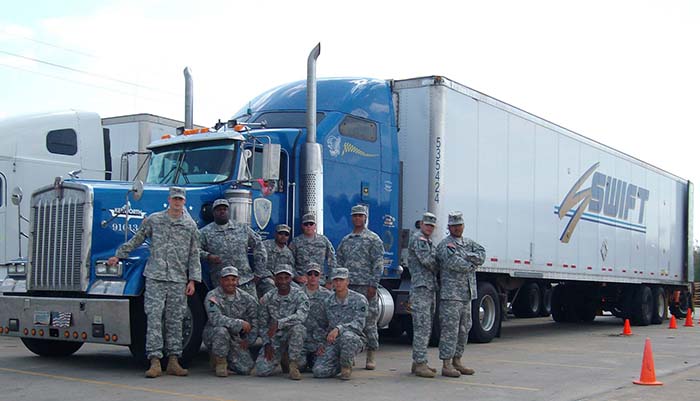
teenage truck driver

Another problem is that it’s very different working for the nation’s security as opposed to a for-profit trucking company that’s looking out for its bottom line. When rushed by their customers and bosses, young truck drivers are more likely to make deadly mistakes. Eric Penucci, a veteran truck driver interviewed by NPR said, “There’s a lot of stress in the trucking business. All customers are in a hurry to get their stuff. Traffic causes delays. Truck drivers need to be experienced, calm under pressure, and able to make good decisions.”

The trucking industry is facing a shortage of drivers, which may only get worse. Older and experienced drivers are retiring or leaving the industry altogether. Future truck drivers may be overworked, underage, and less-knowledgeable on roadway safety. These factors create fatalities on our highways that will only grow unless safer policies are put in place.

I am a truck accident lawyer in Chicago and often times I am dealing with the tragedy these accidents bring to families and communities. If you or your loved one was injured in an accident involving a truck you shouldn’t feel alone. Get the help and legal representation that will help you or your loved one move forward. Committed to your needs, our truck accident attorneys understand what you may be going through. The Dinizulu Law Group, Ltd. is available to answer all your questions and help you navigate through this difficult time. Our number is 312-384-1920 and 1-800-693-1LAW, or reach us by email at info@dinizululawgroup.com.

Cars Have Gotten Safer. Have Trucks?


The Insurance Institute for Highway Safety has reported that over the past few decades cars have gotten safer and fatalities have gone down. This trend can be linked to advances in safety features, such as airbags, electronic stability control, and anti-lock brakes, among other technical advances.

While this same technology is also available for trucks and trailers, the trucking industry hasn’t implemented such safety equipment. In United States, only about 3% of the Class 8 trucks—the heaviest ones which includes most tractor-trailers—are equipped with any collision-avoidance technology. In Europe, most such heavy trucks are sold with this technology.

These large trucks are disproportionately involved in fatal accidents. According to the New York Times, these heavy trucks are involved in 1 out of 8 of all fatal accidents and 25% of all fatalities in construction-zone accidents.

The trucking industry claims the cost of these safety technologies hurt their bottom line. The trucking industry, through its chief trade group, the American Trucking Association, continues to lobby Congress against safety laws, claiming expenditures on safety technology will raise rates for shippers and consumers.

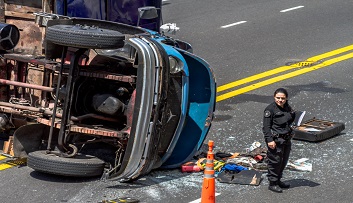
Policewoman directs traffic after a truck accident

But what the trucking industry has failed to notice is that stronger safety measures prevent higher insurance rates and also prevent millions of dollars from being spent in resolving injury claims. The Centers for Disease Control and Prevention also estimates $99 billion  to be the annual cost to the economy for truck and large vehicle crashes.

Many of these expenditures can be avoided if Congress were to pass a common-sense safety bill that addresses the concerns of car drivers, truck drivers, and creates a trucking industry that is safer and more profitable in the long run.

At the Dinizulu Law Group, Ltd., we are safety advocates. Those who injure others through their careless actions must be held accountable for their wrongdoing. That is why our team of truck accident lawyers in Chicago has your back. With over 50 years of combined experience, we know the strategies the defense will use to discredit your injuries. But we bring commitment and expertise to each case and help you get results. Set up a free initial consultation with one of our truck accident attorneys in Chicago. Call 1 (312) 384-1920 or 1 (800) 693-1LAW, or reach us by email.

Client’s Powerful Testimonial: I Was Hit By A Improperly Loaded Truck on the Highway


Fletcher McQueen was injured when a driver of a improperly loaded trailer truck carrying a Bobcat skid steer, lost control and crashed into Fletcher’s SUV. Fletcher was hurt, unable to work, and didn’t know who to turn to. Another attorney who Fletcher had known highly recommended Yao Dinizulu and the DLG law firm.

There were days when Fletcher went to bed in severe pain, not knowing what would happen and if he would ever be able to work again and support his family. The Dinizulu Law Group, Ltd. was able to take Fletcher’s case to trial. The jury ruled in favor of Fletcher with a verdict resulting  in over one hundred thousand dollars for his pain and suffering, lost wages, and medical bills. The next day, the jury reached an additional verdict of $1 million dollars for punitive damages.

Fletcher testifies how the attorneys and staff of the Dinizulu Law Group, Ltd. kept him and his family informed about the latest developments in his case. Fletcher always felt there was clear communication coming from the attorneys, paralegals, and the firm’s legal assistants. Fletcher felt prepared and knew what was expected at trial and during his sworn statement.

The trial verdict helped Fletcher and his family move forward after what was a very difficult chapter in their lives. Fletcher felt like he was finally able to get his life back.

No one who is injured and suffering due to the fault of others should feel like they are alone. Contact the Dinizulu Law Group, Ltd. at 1-312-384-1920 or 1-800-693-1LAW, or by email. We are truck accident attorneys in Chicago that are here to help.

What Are Punitive Damages?


When it comes to personal injury lawsuit in Illinois, there are two typical types of damages that can be given in a verdict: compensatory damages and punitive damages. The main purpose of compensatory damages is to try and make a victim whole. It’s to fix what can fixed or make up for what could not be fixed. An injured victim may be facing debilitating injuries and disability.  In addition to these significant physical and emotional injuries, they may have lost wages, medical bills, and much more. Such injuries and costs fall under compensatory damages.

However, punitive damages are different. Punitive damages are meant to stop a wrong doer from continuing to do wrong. If a person or a business shows through their own actions that they are devaluing the sanctity of life and limb, Illinois law has offered the community a remedy that can be used to stop this dangerous conduct before it harms us all.

The dangerous conduct may have only harmed one person superficially, but this damage is intended to stop the wrong conduct before it worsens. Punitive damages are meant to be a deterrent to the defendant and other similar wrongdoers for their reckless behavior. Unfortunately, many wrongdoers are encouraged to rectify their conduct only through a punitive monetary verdict. It’s these punitive damages that force them to take preventative measures before they harm more people in our community.

At the Dinizulu Law Group, Ltd., we understand that even one injury is too many. During trial, we often seek punitive damages so our communities are safer and our citizens are protected from the reckless behavior of others. With over 60 years of combined experience, our Chicago personal injury attorneys are known for their expertise and tough litigation. Contact us by email or call us at 312-384-1920 to schedule a consultation with one of our personal injury trial attorneys practicing law throughout Illinois.

Translate »