Tag Archive for: Chicago IL

Posts

What Are a Nursing Home Resident’s Financial Rights?

When you think of a nursing home, you probably imagine many elderly individuals living there who rely on staff members to help them with their everyday tasks. While it is true that most do require around the clock assistance, there are plenty of residents who still act independently and are able to manage certain areas of their life. Take finances, for instance. A large portion of residents living in a nursing home in Illinois still have the mental capacity to make financial decisions and even handle their own money. According to The Consumer Voice, some of the financial rights a nursing home resident has include:

  • They have the right to handle their own bank accounts and money.
  • They have access to their funds on weekdays during business hours.
  • They are able to withdraw as much of their own money as they choose.
  • They can keep their spending habits private.
  • They can receive an itemized account of their monthly bill.
  • They can appoint a person to handle their finances.

Because a nursing home resident may still have access to their funds, many individuals, including workers and even family members, will sometimes take advantage of their vulnerability and steal from them. This is referred to as financial abuse or financial exploitation. Because this is a serious issue many aging individuals are faced with today, it is important that if you are considering allowing someone to manage your money, it is someone you can trust.

What are some preventative measures that can be taken to avoid theft in a nursing home?

Aside from financial abuse, nursing home residents also find themselves faced with other issues including having their valuable items taken from them should they choose to bring them when they transition from living in their own home and into a nursing home. Because we understand how important these items may be as they may not only hold value but also a place in your heart, it is important that you take preventative measures to avoid from becoming a victim of theft during your stay. Some preventative measures The Consumer Voice recommends you take include:

  • Mark all of your personal items, including watches, dentures, eyeglasses, and hearing aids, etc. so that everyone knows who they belong to.
  • Keep a written inventory checklist of clothing and other valuables, signed by you and a representative from the facility.
  • Provide your family members with a copy of the inventory checklist as well.
  • Take pictures of your valuable items.
  • Keep copies of all receipts for any items taken into the facility.
  • Place locks on clothing drawers and/or cabinets, where only you and an administrator have a key to open it.

What should I do if I am the victim of financial abuse?

If you or your aging relative has become the victim of financial abuse and you believe an Illinois nursing home employee is inflicting this abuse, you are encouraged to contact the Chicago, IL nursing home abuse lawyers at Dinizulu Law Group, Ltd. Our dedicated team of attorneys can investigate into the matter and gather all the necessary evidence that proves you or your loved one is, in fact, the victim of such abuse. We can then explain what options are available in terms of taking legal action and help you make an informed decision as to which may be the best for you to pursue.

To schedule a consultation to learn more about nursing home financial abuse and how we can serve as an advocate for you and your loved one, contact us today at (312) 384-1920.

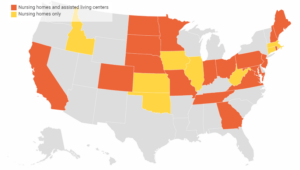
Some States Begin to Allow Nursing Home Visitation

CHICAGO, IL – For millions of American families, the COVID-19 pandemic has restricted families from visiting their loved ones in nursing homes and assisted living centers. Now, as many states begin to roll back strict policies initially put in place when the pandemic began, some families finally have the opportunity to see their loved ones in person.

With new guidance from the Centers for Medicare and Medicaid Services (CMS) and the Centers for Disease Control and Prevention (CDC), nursing homes are allowed to use more creative measures to allow visits from family members.

What States Allow Nursing Home Visitation?

So far, 26 states are starting to allow nursing home visitation, while 18 others are planning similar visitation guidelines for assisted living facilities.

Nursing homes are allowing visitors; however, visitors will have to follow specific guidelines. These guidelines include:

  • Families must schedule an appointment to visit residents in advance
  • Visitors must undergo a temperature check and answer a COVID-19 screening questionnaire
  • Only 1 or 2 visitors can visit at a time
  • Visits must take place outside on a patio or garden area
  • No physical contact such as hugs are allowed
  • All visits will be supervised by a staff member
  • Visitors must practice social distancing by remaining 6 feet away from residents and staff

If a resident or staff member develops COVID-19, then the facility will ban all nursing home visitations. State officials may also implement a no-visitation policy if state officials note a significant rise in COVID-19 cases.

Understanding the Risks of Allowing Nursing Home Visitation

After nearly four months in isolation, many families feel relief knowing they can once again visit their loved ones. Between being isolated and COVID-19, the pandemic has taken a serious toll on the physical and mental health of residents nationwide. Residents have very limited interaction with other residents and staff and are confined to being in their rooms most of the time.

It’s important to understand that while this is step in the right direction, there’s also many risks to visiting your loved one in a nursing facility. Nursing home residents are the most vulnerable to contract COVID-19. Nearly 45 percent of COVID-19 deaths have occurred in long-term facilities.

Many families have expressed their concern over their loved one being neglected or abused during the lockdown. Without their involvement and oversight, families are worried their loved one has not received adequate care.

Learn More about Nursing Home Residents Rights

The COVID-19 pandemic has changed the way everything operates, especially nursing homes; however, nursing home residents still have rights. They have the right to quality care that ensures a safe and healthy life.

If you have concerns regarding the quality of care your loved one is receiving in a nursing home, please contact the experienced attorneys at the Dinizulu Law Group, Ltd. Our legal team will help you understand the rights of nursing home residents and ensure that your loved one gets the care he or she deserves. Even during a pandemic, we want you to know your loved one’s legal rights and know that you are not alone.

If you have any questions, please call our office at (312) 384-1920 for a free consultation or visit our website for more information.

Hyundai, Kia Agree to $758 Million Engine Fire Class Action Settlement

CHICAGO, IL – Hyundai and Kia have reached a $758 million settlement with car owners who claim that their vehicles suffer from premature engine failure which has caused cars to burst into flames. The class action lawsuits allege that the car companies were aware of the defect but did not disclose this information to customers. The settlement includes nearly 4.1 million car owners who bought a number affected vehicles.

According to the motion for approval of the class action settlement, the vehicles that are part of this Class include: “all 2011-2018 and certain 2019 model year Hyundai Sonata vehicles, all 2013-2018 and certain 2019 Hyundai Santa Fe Sport vehicles, all 2014-2015, 2018, and certain 2019 Hyundai Tucson vehicles, all 2011-2018 and certain 2019 Kia Optima vehicles, all 2011-2018 and certain 2019 Kia Sorento vehicles, and all 2011-2018 and 2019 Kia Sportage vehicles originally equipped with or replaced with a genuine Theta II 2.0 liter or 2.4 liter gasoline direct injection engine within OEM specifications.”

Due to defects highlight in the settlement agreement, Hyundai and Kia cars reportedly caught fire, resulting in personal injury claims such as property damage and/or physical injury. In extreme circumstances, the defects resulted in houses and/or garages being burned down.

Holding auto manufacturers liable for defective vehicles is never a simple task.  At the law office of the Dinizulu Law Group, Ltd., we take on tough cases against large corporations, and we know how to fight for your right as a consumer. Call (312) 384-1920 or contact us on our website for a free consultation with a Chicago personal injury attorney.

The History and Evolution of Rape Kits

CHICAGO, IL – Marty Goddard to revolutionize the first standardized rape kit in Chicago while she was volunteering at a crisis hotline for teenagers.

The first rape kit was sent to nearly 25 hospitals in the Chicagoland area in 1978 for a pilot program she designed. By the end of the following year, almost 3,000 rape kits had been turned over to crime labs. Within a few short years, the city collected thousands of sealed kits containing evidence and began putting rapists in prison.

In the United States today, someone is sexually assaulted every 73 seconds. Research shows a wide range of reasons why people don’t report their experience with sexual assault or harassment to authorities, and even hide it from family and friends. Self-blame is one reason people don’t report because victims blame themselves for their own victimization. Another reason is many people who have been raped don’t recognize it as rape, even if it fits the legal definition. Many people also fear speaking out against their abuser because their rape kit may be backlogged and never be tested by law enforcement.

It has been estimated that hundreds of thousands of rape kits sit untested in police departments and crime lab storage facilities.

Officials in Illinois have been promising for years to clear and keep a clear backlog by hiring more forensic scientists and utilizing robotics to make the process more efficient and transparent. Illinois governors have allotted funding toward fixing the problem dating back to 2002, when Gov. George Ryan announced funds to “erase” a backlog that had reached nearly 3,000 cases held up at state forensic labs. The plethora of untested rape kits and the destruction of rape kits indicates a systemic problem in our culture and a distinct failure to regard sexual crimes as seriously as other crimes.

If you or a loved one is a victim of sexual abused, you need an experienced attorney to explain your legal options. Filing a sexual abuse claim against an abuser or organization (whether it’s a school employee, a foster parent, a coach or grossly inadequate secured facility) that is responsible for allowing the abuse to be committed can be intimidating. The attorneys at the Dinizulu Law Group understand how you feel and are prepared to support you in every way necessary in order to help you get the compensation you deserve for the harm that was done to you. Contact our office today at (312) 384-1920 for a free consultation or visit our website for more information.

Motor Vehicle Fatality Rates Jump Despite Quarantines

CHICAGO, IL – There has been much less traffic on the roads because of the novel coronavirus that has resulted in the closing of non-essential businesses and stay-at-home orders that have been in place since mid-March. There has been a reduction in car crashes; however, in some places the number of deaths from car accidents has decreased while others have increased.

Pandemic Traffic Crash Statistics
Some cities and states have seen a significant increase in dangerous car crashes during the pandemic. Through the first three months of 2020, the following states have experienced notable increases in the number of roadway deaths: Arkansas (16%), California (8%), Connecticut (42%), Illinois (11%), Louisiana (23%), Nevada (10%), New York (17%), North Carolina (10%), Oklahoma (9%), Tennessee (6%), and Texas (6%).

States with notable decreases include: Arizona (-4%), Hawaii (-32%), Idaho (-28%), Iowa (-13%), Maryland (-13%), Michigan (-12%), Oregon (-24%), and South Carolina (-12%).

Many people die from roadway accidents, especially during holiday weekends. The National Safety Council (NSC) estimated over Memorial Day weekend that 366 may die on U.S. roads. If the estimate holds, it will be the lowest number of fatalities for the holiday period since 2014.

Reasons for an Increase in Accidents
Reports indicate speeding has increased significantly since traffic has lessened. Some states are moving towards “ill-advised” roadway tactics intended to address the pandemic such as repealing requirements for teen drivers to pass road tests before acquiring licenses and relaxing hours of service rules for commercial vehicle drivers.

Distracted driving may also be more prevalent since there is less traffic, so drivers get a false sense of security and begin to use less caution. Drivers figure they have more time to react, so its OK to look at their cellphone.

“What really strikes me is the incredible speed of the changes we’re seeing on a roadways,” Ken Kolosh, manager of statistics at the National Safety Council, told NPR. “Looking at other recessions what you usually see is a decrease in the number of deaths, or the injuries and fatality rate holding steady or decreasing slightly.”

Driver Precaution
Practicing defensive driving is always important, and it is particularly important during the pandemic, as drivers may be much more reckless. To help ensure safer roads, NSC urges people to do the following while on the road:

  • Follow state and local directives and stay off the roads if officials have directed you to do so; many states are asking drivers to stay home unless it’s an emergency situation or for essential errands
  • Obey speed limits, even if roads are clear and traffic is light
  • Practice defensive driving: Buckle up, designate a sober driver if you’re going out drinking or arrange alternative transportation, get plenty of sleep to avoid fatigue, and avoid distractions
  • Be aware of increased pedestrians and bicycle traffic as people turn more to walking and biking to get out of their house safely during quarantine
  • Stay engaged with teen drivers’ habits and practice with them frequently (tips available here)
  • Organizations and employers are encouraged to join the Road to Zero Coalition, a group committed to eliminating roadway deaths by 2050

NSC collects fatality data monthly from all 50 states and the District of Columbia and uses data from the National Center of Health Statistics, so deaths occurring within one year of the crash on public and private roadways–such as parking lots and driveways–are included in the estimates. NSC motor vehicle crashes and estimates for each state can be reviewed here.

Injured in an Auto Accident? Our Licensed Attorneys Can Help

If you suffered injuries in a car crashed caused by someone’s negligence, or you lost a loved one in an accident, please call the Dinizulu Law Group for a free consultation. We may be able to help you seek compensation for your damages. With more than 50 years of experience, our legal team has protected and brought justice to victims and their families through Chicago and Illinois. Due to the statute of limitations, it’s important you inquire with an experienced attorney immediately to preserve your legal rights. For a free consultation, call (312) 384-1920 or visit our website for more information.

How to Find a Quality Nursing Home During a Pandemic

CHICAGO, IL – The novel coronavirus is uprooting many areas of life for people across the world. For families that considering nursing home care for their loved one, it’s causing people to rethink such a move. Nursing homes have been the epicenter of coronavirus outbreaks, which certainly can lead to concern; however, this doesn’t mean you should stop looking into nursing homes.

While COVID-19 is certainly a risk factor that one should consider, families should also consider nursing home abuse and illness outbreaks happen daily in nursing home settings. No matter what the concerns are, there are some things that families can do to research and find a quality nursing home facility for their loved one – even during a pandemic.

Determine a Budget

One of the first steps while choosing a nursing home is determining what your family can afford. First, start by determining how much care your loved one needs. Does he or she require daily medical care and supervision? Does he or she need limited care, such as assistance with meals or medication reminders? These are things that will factor into the cost.

Determining the amount of care your loved one needs will help determine if you need assisted living or nursing home care. This will also help you narrow down your budget which will narrow down your field of choices.

Nursing homes can be more expensive because they require more specialized staff, nursing staff, and medical care. Nursing homes tend to have much stricter regulations, such as regulations for staffing, services, and food safety. On the other hand, assisted living facilities have less restricted regulations because there is less involvement in the daily needs of their residents.

Use Online Resources for Your Search

There are several legitimate online resources and tools you can use to help identify and review nursing homes you may be considering. If you are considering a facility that accepts Medicaid or Medicare, the best place to start your search is utilizing Medicare’s Nursing Home Compare tool. This tool is excellent to use because they have data on staffing, data on incidents, and can tell you the number of residents that have suffered from bedsores.

You can also find information through your state’s long-term care Ombudsman office. The Long-Term Care Ombudsman Program offers important information about nursing homes and assisted living facilities.

Visit the Facility

Before deciding on a nursing home, it’s important to visit the facility first. Don’t just settle for an informal meeting with the administrator – talk to the staff members who will potentially be caring for your loved one. Ask to meet with the nursing director and nursing assistants (CNAs). These are the people who will be interacting and caring for your loved one the most. It’s important to take note of what they’re saying and what their attitudes are like. Do they have a mean demeanor? Do they seem to enjoy their work? Do they seem tired or overwhelmed? Notice how they come across now and imagine how they will respond to your loved ones needs during a difficult shift.

Do More than a Guided Tour

Most nursing homes offer a guided tour of the facility and show where your loved one will be sleeping, the activity area, and the dining room. This is a great way to see an overview of the facility and what they have to offer, but this should not be the only way to assess the facility. When visiting, be mindful of a few things:

  • Residents – Do residents seem to be well-groomed? Do they seem to be happy? Are they actively moving around?
  • Food Service – Take note of what meals look like and how residents are reacting. Do they seem to enjoy it? Are residents complaining about the food quality?
  • Smells – Do you notice a smell or urine or strong cleaning products?
  • Sounds – Does it sound pleasant? Is there music playing? Do you hear upset residents that are crying or grumbling?

When visiting a nursing home, these are important factors to consider. If anything seems off to you, it’s likely a sign that this isn’t the best nursing home suited for your loved one.

Discuss Important Issues Before Signing Paperwork

Once you’ve narrowed down your list on possible nursing homes, it’s important to discuss certain issues before you sign any paperwork. It’s important to discuss your loved ones medical records since you can’t assume you will have access to their medical records once they are living at the facility. Ask the facility what they require to make sure you have all relevant medical information to help make medical decisions.

You should also discuss the plan for your loved one’s care. Ask the nursing home facility how they establish a care plan for residents. Most facilities will have a meeting with nursing staff to discuss the resident’s needs where families should be present.

Do You Have Concerns about Your Loved Ones Care in a Nursing Home?

If you have questions or concerns about the care your loved one is receiving in a nursing home, contact the attorneys at the Dinizulu Law Group. We help families understand their legal rights and options to ensure their loved ones are safe. To request a free consultation, please call (312) 384-1920 or visit our website for more information.

Ahmaud Arbery: Witness Says Before Shooting the McMichaels Hit Him with Their Car

CHICAGO, IL – The three white men who are accused of killing Ahmaud Arbery faced a Glynn County judge Thursday morning for their preliminary and bond hearings. Arbery, an unarmed black man, was being pursued by Travis and Gregory McMichael, two white man, when he was gunned down while jogging on February 23 near Brunswick, Georgia.

A 28-second cell phone video of Arbery being shot and killed flooded social media platforms months later and the public called for the McMichaels to be arrested. On May 5, officials with the Georgia Bureau of Investigations secured search warrants to arrest the McMichaels on murder and aggravated assault charges. On May 21, the man who filmed the killing, William “Roddie” Bryan, was arrested on felony murder charges.

The three men engaged in an elaborate chase, hitting the 25-year-old jogger with a truck as he tried to escape them. Richard Dial, GBI Assistant Special Agent in Charge, was asked whether he believed McMichael could’ve been acting in self-defense, he said it was Arbery who was defending himself.

“I believe Mr. Arbery was being pursued, and he ran until he couldn’t run anymore, and it was he turned his back to a man with a shotgun or fight with his bare hands against the man with the shotgun. He chose to fight,” Dial said according to CNN. “I believe Mr. Arbery’s decision was to just try to get away, and when he felt like he could not escape he chose to fight.”

As Travis and Gregory McMichael attempted to head him off, Arbery then turned and ran past the truck of Bryan who struck Arbery with the side of his truck. Investigators found a swipe from a palm print on the rear door of Bryan’s truck, cotton fibers near the truck bed that are attributed to contact with Arbery, and a dent below the fibers.

Arbery’s last moments emerged amid a week of nationwide protests over another killing – of George Floyd by police in Minneapolis – and demonstrators have called for justice in Arbery’s case.

Dial also testified that there were numerous times on social media that McMichael used the same slur words to describe people of color. Dial did not say which McMichael he was referring to and was not asked to clarify.

The Justice Department has launched a hate crime investigation in this case. With tensions already running high in Brunswick and the rest of the country, Georgia Governor Brian Kemp said the state will do “whatever is necessary to keep the peace.”

Effects of Understaffing in Nursing Homes

Nursing home facilities across the nation are facing an understaffing crisis. Research has shown nearly 95 percent of nursing facilities in the United States are understaffed. Understaffing can lead to serious injuries, or in some cases death among residents. Some states, such as New York, don’t have a legal mandate on the ratio of nursing home staff to senior residents, which means problems can often go unnoticed.

Understanding the Issue of Understaffing
Understaffing in nursing homes is a serious, prevalent problem that often goes underreported. There is often pressure for nursing facilities to cut costs. This can result in facilities taking in more residents than what they’re staff can effectively and adequately handle. Understaffing can mean that a single nurse must care for dozens of residents at one time.

Nursing facilities may find that they have having problems holding onto enough adequately trained nurses and certified nursing assistants who can provide care to residents. High turnover rates can result in the over-scheduling of available staff members, who then in turn become overwhelmed by their duties.

Understaffing in nursing facilities can also lead to nursing home abuse. Staff are overwhelmed while being underpaid, which can lead staff members or caregivers to be more abusive towards their residents. Forms of abuse can include physical or sexual injuries, financial exploitation, and psychological trauma. Staff members can also neglect the needs of vulnerable residents by not giving out the proper dosage of medication or the proper medication, for example.

Consequences of Nursing Home Understaffing
There can be negative consequences of understaffing in nursing homes which can affect residents’ basic needs. Staff members may be suffering from extensive stress, which increases the likelihood of nursing home abuse and neglect. Abuse and neglect become a bigger issue as the resident to staff member ratio increases.

Neglect and abuse from nursing home staff can cause long term issues, such as psychological problems, physical illnesses, and even death in some circumstances. Understaffing can attribute to already present psychological issues or physical illnesses among residents.

Consequences of Immobile Patients
Many residents suffer from limited ability to ambulate on their own and are dependent on caregivers for all of their movement needs, as well as their physiological needs. When a nursing facility is understaffed, it can be impossible for staff members to turn the patients in bed enough times or to move residents around as they need to be moved in order to prevent bedsores. This can lead to further skin conditions or infections.

Neglecting Residents Needs
Residents may be dependent on caregivers and nursing home staff for their bathing, eating, grooming, and medication administration needs. If a resident is not bathed or groomed on a regular basis, they may develop sores and infections. Facilities that are understaffed may have problems with feeding and administering medication to residents on a routine schedule. This may lead to malnutrition, nutrition deficiencies, and other complications from not receiving medications on schedule.

The Abuse of Residents
Understaffing in nursing homes can also lead to the neglect and abuse of residents in the facility. Abusive nurses have indicated stress from understaffing is the primary cause of their being abusive to residents. Having limited time to care for each resident can result in caregivers or nursing home staff to become impatient and frustrated, resulting in abuse towards a resident.

Prevalence of Understaffing in Nursing Homes in U.S.
Each state has a different definition of what constitutes as adequate staffing levels for nursing homes; however, research indicates nearly 95 percent of nursing facilities in the United States are significantly understaffed. In 2001, 20 states introduced a total of more than 50 Bills on nursing staff standards in nursing homes.

For example, Illinois requires that a nursing home have enough staff to give each resident that needs skilled care at least 3.4 hours of nursing care, including at least 51 minutes of licensed nurse care. At least 21 minutes of the licensed nurse time bust be care by a registered nurse (R.N). For residents who are in need of intermediate care, the numbers include 2.3 hours of total nursing care, including 34 minutes by a licensed nurse and 14 minutes of registered nurse time (Illinois Citizens for Better Care).

Eleven states, including Florida, Massachusetts, Michigan, Minnesota, New Jersey, New York, Ohio, Pennsylvania, Tennessee, Texas, and West Virginia have proposed staffing increases that were not passed.

Four states (Hawaii, Minnesota, Montana, and Wyoming) have not changed their staffing standards since the 1970-1980s. Furthermore, eighteen sates made changes to their staffing standards in the 1990s.

Preventing Understaffing in Nursing Homes
Many nursing homes have been held accountable for issues related to understaffing in recent years through lawsuits. While this may be a temporary fix to the problem, there is much more work to be done in order to combat this issue. Because of understaffing, nursing homes nationwide have had to pay out millions of dollars to patients who have suffered from wrongful death and illnesses that are related to the understaffing in nursing facilities.

If a nursing home facility fails to provide adequate staff and supervision, it can have a serious impact on residents who depend on nurses, caregivers, and other staff members for care.

If you or a loved one has experienced abuse or neglect at the hands of a caregiver, we recommend you contact an experienced nursing home neglect and abuse attorney right away. Our team has proven success in nursing home cases and we will use our extensive legal experience to help you navigate the process to get you full and fair compensation for our loved ones injuries. To receive a free consultation, please call (312) 384-1920 or visit our website for more information.

How Can Negligent Hiring and Supervision Lead to Nursing Home Abuse?

Nursing homes are responsible for ensuring residents are properly cared for in a safe and healthy environment; however, when a facility and its administrators fail to hire qualified staff, provide inadequate training, or poorly supervise employees, these shortcuts could result in harm, or even death, to a resident.

What is Negligent Hiring?

Negligent hiring is “a claim made by an injured party against an employer based on theory that the employer knew or should have known about the employee’s background which, if known, indicates dangerous or untrustworthy character,” according to US Legal. Performing a proper background check could include the following:

  • Checking employment and personal references
  • Validating college degrees, certifications, and licenses
  • Performing a drug screening
  • Performing a criminal screening
  • Performing a credit check
  • Checking driving records

Examples of Negligent Hiring

There are several ways that negligent hiring could lead to resident abuse. For example, a nurse with a fraudulent degree from a non-accredited college who performs CPR on a resident could result in death. Another example is a newly hired staff member who has had a history of anger issues attacking a resident and causes injury to them.

What is Negligent Supervision?

There are several ways negligent supervision could lead to resident abuse. An example of negligent supervision would be if a registered nurse who was known to sign off on medications but never properly administered it to residents, and a resident later dies as a result of not receiving that medication. Many times, nurses will sign off saying they gave the resident their medication but didn’t. The employer was made aware that the registered nurse was doing this and didn’t address it, which leads to negligent supervision.

Examples of Negligent Supervision

There are several ways negligent supervision could lead to resident abuse, for example, an administrator of the facility is aware that a nurse and a resident don’t get along, but still assigns the nurse to work that resident, an argument could turn into a physical altercation, resulting in the resident being hurt. Another example is if a staff member knows several items have been missing from a residents’ room under the supervision of the same caregiver but doesn’t investigate, discharge, or reassign employees, the caregiver could end up stealing the resident’s identity and racking up thousands of dollars.

What To Do If You Suspect Abuse

If a nursing home facility fails to provide the proper hiring and supervision, it can have a serious impact on residents who depend on nurses, caregivers, and other staff members for care.

If you or a loved one has experienced abuse or neglect at the hands of a caregiver, we recommend you contact an experienced nursing home neglect and abuse attorney right away. Our team has proven success in nursing home cases and we will use our extensive legal experience to help you navigate the process to get you full and fair compensation for our loved ones injuries. To receive a free consultation, please call (312) 384-1920 or visit our website for more information.

Why Do Nursing Homes Drug Dementia Patients Without Their Consent?

The Human Rights Watch estimates nearly 179,000 people in nursing homes are administered antipsychotic drugs every week without having a diagnosis for which the drug is approved. The use of antipsychotic drugs as chemical restraints has a long, disturbing history in nursing homes. Many times, staff members use antipsychotics to convenience or “discipline” a resident.

Manufacturers have faced many civil and criminal penalties in the last decade for the misbranding of the medication to promote the drug as appropriate to treat older people suffering from dementia. The Food and Drug Administration (FDA) has required manufacturers to place a “black box warning” on the packaging, advising against the medicine and the side effects it may have on an individual. Antipsychotics being administered to someone with dementia almost doubles the risk of death for them and have never been approved as safe or effective. Despite the warning, nursing homes still administer antipsychotic drugs, sometimes without informed consent first, which is a violation of federal regulation and a person’s human rights.

Antipsychotics are powerful drugs developed to treat schizophrenia; however, nursing home staff often administer them to those with dementia for the sedative effects. Government regulations prohibits the use of drugs as chemical restraints or without informed consent.

Antipsychotics are misused for a variety of reasons, including the misperception by nursing homes that medications may help those with dementia, lack of awareness of the danger of the drug, lack of training in dementia care, and possibly the most significant, to compensate for understaffing. Kaiser Health News found that nursing homes have been exaggerating levels of nursing and caretaking staff for years, according to The Washington Post.

In most cases, antipsychotic drugs are administered in a harmful way without the appropriate consent. Nursing home residents and family members have reported the resident was given the medication without their knowledge, awareness of risks or dangers, or any objections of their own. Staff members have admitted they we not aware of an informed-consent policy, rather they gave it to the resident out of their own convenience. Nursing staff, pharmacists, and medical directors commonly prescribed medication to residents without even seeing them.

Antipsychotic drugs are a favorite among psychotropic medications in nursing home facilities because dementia is associated with aggression, anxiety, agitation, delusions, disinhibition, irritability, and wandering. Federal regulations say residents have a right to be informed of their treatment, or their right to refuse treatment; however, nursing homes ignore these rules, partly because they are rarely held accountable.

An 81-year-old man in Texas spoke out about his experience being over medicated, saying, “too many times I’m given too many pills. I can’t even talk. I have a thick tongue when they do that. I ask them not to give me the antipsychotic drugs. When I say that, they threaten to remove me from the home. They get me so I can’t think.”

The Human Rights Watch found 97 percent of citations for violations at nursing homes were related to antipsychotic drugs from 2014 to 2017. In almost no cases, the government did not impose financial penalties, leading to the likelihood of it occurring again. Nursing homes are mostly a for-profit industry, controlling most aspects of their residents’ lives.

If you or a loved one is injured due to a medication error you believe was unnecessary or wrongfully given, reach out to one of our experienced nursing home abuse attorneys. We have helped thousands of wronged victims get the justice and compensation they deserve. With over 50 years of combined experience, our verdicts and settlements have helped clients have a peace of mind and security. Please call the Dinizulu Law Group at (312) 384-1920 to schedule a free consultation or visit our website for more information.

Translate »