Archive for category: Workplace Discrimination

Forced Arbitration & Worker Safety – What is at Stake?


It is estimated that more than half of all American workers are subject to forced arbitration clauses. When this happens, employees can either choose to keep their jobs or sign a contract in which they forfeit their right to sue the company should a dispute arise. Signing an arbitration clause may also mean waiving the right to an appeal and, oftentimes, waiving the right to participate in a class action lawsuit.

The arbitration process means that rather than having employee disputes heard by a trial by jury, an arbitrator—or a neutral third party—will hear both sides and make the decision behind closed doors. This process typically favors the employer and keeps the issue out of the public eye.

When it comes to issues of sexual harassment or gender discrimination in the work place, these mandatory arbitration clauses become even more burdensome for employees. Meanwhile, a predatory culture of discrimination, intimidation and harassment is allowed to prevail at American workplaces.

sexual-assault-non-disclosure-agreement

Illinois Congresswoman Rep. Cheri Bustos introduced a bill at the end of last year that would end forced arbitration in sexual harassment cases. The bill, named the Ending Forced Arbitration of Sexual Harassment Act of 2017, has drawn bipartisan support in both chambers of Congress. While other Congress members from Illinois, such as Sen. Dick Durbin and Rep. Luis Gutierrez have endorsed the bill, there still needs to be more widespread support for this bill.

At the Dinizulu Law Group, Ltd., our civil rights and personal injury lawyers firmly believe that the right to a trial by jury is vital to our justice system. Forced arbitration not only prevents victims from getting the justice they deserve but silences them through intimidation while allowing the abuse to continue.

If you believe you are being discriminated against at work or were demoted or fired for reporting inappropriate behavior, know that there are options for you. The Dinizulu Law Group, Ltd. has over 50 years of combined experience and expertise to help you get the justice you deserve. Contact us at 1 (312) 384-1920 or 1 (800) 693-1LAW, or by email.


Who Has The Power To Enforce Laws?


When the United States established our institution of government through the Constitution the jury system was enshrined in that document. The 6th and 7th amendment were later added to the Constitution and protected the right to juries in criminal and civil cases.

But still more was needed to enforce this cherished right. African-Americans under federal law were given the right to serve on juries in 1875, but in practice many were openly and routinely removed from juries based on race until a US Supreme Court case in 1986 declared that conduct was prohibited by the constitution. Watch the video to learn more.

As late as 1942, only 28 states had laws that allowed women to serve as jurors, but these states also gave them the right to claim exemption based on their sex. The Civil Rights Act of 1957 gave women the right to serve on federal juries, but not until 1973 could women serve on juries in all fifty states.

The right to serve on jury is something people fought for and died for because this right is so important to the fabric of our laws. The primary purposes of civil tort law in America and here in Illinois as described by the Illinois Supreme Court is when someone has been wrongly injured by the acts of another the law is to:

  • to compensate the victims;
  • to reduce future wrong acts; and
  • to encourage careful conduct in the future to protect all of our citizens.

The jury enforces these laws through their collective verdict. By serving on juries, you are able to voice your opinion and influence the collective verdict. If you do not show up, you are allowing someone else to decide how the laws should be enforced. Therefore, someone else will have the power to determine the type of community you will live in. So remember, the juries’ verdict is how you enforce the laws of your community. That is why it’s so important to serve.

If you have questions about trial or your own serious injury, contact the Dinizulu Law Group, Ltd. at 312-384-1920 or by email. Our Chicago personal injury attorneys are known for their expertise and tough litigation. Schedule a free consultation with one of our personal injury trial lawyers practicing throughout Illinois.

3 Reasons To Go To Jury Duty


Juries are an important part of the justice system in America and a pillar of our democracy. Our constitution guarantees citizens receive a fair trial that is overseen by an impartial jury. Not only does this create confidence that our laws will apply equally to all, but this is also one of the purest and most immediate way to participate in our justice system. Watch the video to learn more.

Here are more reasons why you should answer that jury summons:

  1. You are giving back to your country. Many of us have never served in the military for our country. Jury service is one of the few times that we can give back to our country by serving on a jury and ensuring that our system of justice is supported.
  2. We are stronger as a country when we serve on a jury with our fellow man and woman as the conscience of the community.
  3. You will prevent absolute power by the politicians and corporations. This is your time to show what your community finds important to enforce or not enforce through your verdict.

A typically jury is made up of 6 to 12 jurors who are peers. Meaning it’s you and your fellow citizens who are asked to serve on a jury. You may be a laborer or a corporate executive. However, when you sit on a jury, it’s a community of equals that are on a jury, rather than a panel of experts. The case may well be about a union laborer who may have been injured or about a physician whose failed to diagnose a child. Either way, it is a collective jury that is to enforce the law and facts that has been presented to you by the judge and the parties.

It is the jury’s collective reasoned choice to interpret the facts and enforce the law. The jury makes the decision on a case, producing a verdict. These verdicts then become a part of what our communities expects from our doctors, lawyers, corporations, hospitals, and more. They outline what you the jury will expect now and in the future from the conduct of us all.  This method of administering justice prevents absolute power. A jury of 6 to 12 people, who all come from different backgrounds and life experiences, must reach a unanimous decision.

So the next time you get that jury summons, make sure to serve. It may be a hassle, but in the end you, like so many others before you, will have made a huge commitment to our democratic system of government. That small burden is a small price to pay for the privileges and protections of our government and laws. With rights, come responsibilities. Jurors owe it to their fellow citizens to perform this service seriously; justice depends all on the quality of jurors who serve. The survival of your own right to trial by jury depends on the willingness of all to serve, so be part of the system and make a difference.

If you have questions about trial or your own serious injury, contact the Dinizulu Law Group, Ltd. at 312-384-1920 or by email. Our Chicago personal injury lawyers are known for their expertise and tough litigation. Schedule a free consultation with one of our personal injury trial attorneys practicing law throughout Illinois.

How Common is Sexual Harassment?

A few months ago, a Chicago-based panel hosted by Justice Anne Burke discussed sexual harassment in the workplace. Stories range from severely aggressive encounters to the less obvious. For example, one woman explains how a man in a position of authority kissed her despite her obvious attempts to push him away. A national study quoted by panel participants indicates that 1 in 3 women are sexually harassed in the workplace, with a significant amount of those occurrences happening in the food services and hospitality industries.

Workplace_sexual_harassment

Sexual harassment takes many forms, and it may not always be obvious. While touching, groping, and indecent exposure may be obvious, jokes, inappropriate compliments or over sharing can also fall into the category of sexual harassment. This form of harassment is not just limited to women either. Data provided by the U.S. Equal Employment Opportunity Commission shows that between 1997 and 2011 between 11% and 16% of all sexual harassment charges were made by men.

Under Illinois Law You Must File your Claim Within 180 Days of Harassment

Under the Illinois Human Rights Act, the state has declared that as a matter of public policy, individuals should be free from sexual harassment in employment situations as well as in academic settings. It further defines sexual harassment as any unwelcome sexual advance or request for sexual favors either explicitly or implicitly. A sexual harassment charge must be made within 180 days of the incident, thus time is of the essence. If you have been the victim of inappropriate behavior in the workplace, you should contact our sexual harassment lawyers right away.

Experienced Attorneys Knows What to Look for in a Sexual Harassment Case

Proving that you were sexually harassed can be difficult as much of the evidence is based on one person claiming something happened and the other person saying that it did not. If you suspect that you are being sexually harassed, then you should document any occurrence and save any hard evidence that will help you prove your case. Additionally, the person you accuse of the harassment is prohibited from destroying records that may incriminate them but that does not always mean that they will act accordingly.

Our experienced sexual abuse attorneys will help you identify the evidence you need to build your case and will also look for any additional wrongful behaviors your harasser may be committing. At the Dinizulu Law Group, Ltd., our experienced and compassionate discrimination and sexual harassment attorneys in Chicago understand the laws prohibiting sexual harassment both in the state of Illinois and on the federal level. Please contact us right away if you suspect that you are falling victim to sexual harassment in any form. Our initial consultation is at no cost to you.

How to Identify Sexual Harassment in the Workplace


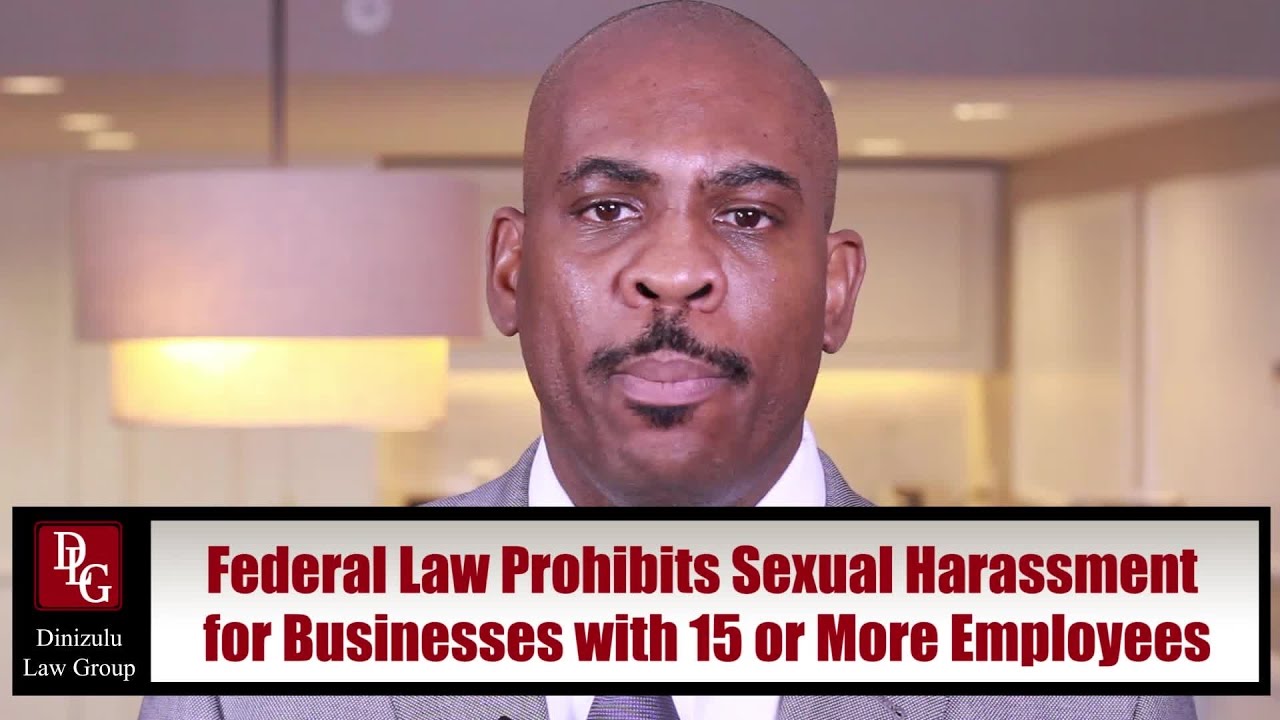
Sexual harassment is a form of discrimination.  In the workplace, it is illegal under Title VII law.  So, how do you define it and what does it look like? Watch the video to learn more.

There are both federal and state laws the protect individuals from workplace sexual harassment. Title VII is the federal law that protects employees in businesses with 15 or more employees. Sexual harassment is defined as unwelcome sexual advances or conduct that interferes with an employee’s ability to work or that creates an offensive or a hostile workplace environment.  It happens across genders.

There are two forms of harassment to know about.  The first is quid pro quo.  This is when a person in charge demands that employees tolerate sexual conduct in order to keep their jobs or retain their access to things such as promotions.  One claim is usually enough to establish a quid pro quo case.

The second type of harassment is hostile work environment harassment. The conduct has to be repeated and deemed offensive enough to create a hostile work environment to have a legal backing. The court will take into account what type of conduct it was, the frequency of the conduct, whether or not he conduct was offensive, whether the harasser is a coworker or supervisor, who else joined in, and whether the harassment included others. Watch the video to learn more.

Navigating sexual abuse cases can be confusing, and it helps immensely to have experienced sexual harassment lawyers on your side. If you have questions about sexual harassment, please email or call us at 312-384-1920 or 1-800-693-1LAW.  Our experienced Chicago-based sexual abuse and job discrimination attorneys are here for you. You may also find more videos and media content from the Dinizulu Law Group, Ltd. on our media page.

How We Proved A Job Discrimination Case Involving Self-Defense


Discrimination cases can be tricky.  You have to prove that there was adverse action taken against one party when there was none taken against another party, and that can be difficult to do.

Imagine this: There are two individuals.  They both have similar stories.  They attended the same high school.  They both served in the military.  They both worked for the same company.  What’s different about them?  One is African American and one is Caucasian.  One was fired and one was not.  Let’s consider what we needed to prove for this discrimination case.

The African American party was sent out on a stranded motorist call.  Upon arriving, the motorist began to get aggressive.  It was the company’s policy that the employee is responsible for walking away from situations in which the motorist becomes angry.  Let’s call the emergency roadside assistant Bob.  Bob walked away from the motorist.  While he was trying to walk away, the motorist grabbed Bob.  Bob did not expect that, and did not know what was going to happen beside the road, so he hit the motorist in self-defense.  He was suspended and then fired.  He had just bought a retirement house, and had been working extra to save for his retirement.  He was only two years away from retirement.

Now, let’s look at the other party.  We’ll call him Joe.  Joe was also called out to help a stranded motorist.  In the process, he hit another motorist.  The driver of that car got upset and proceeded to throw hot coffee all over Joe.  Joe got upset and chased down the driver.  When he got to him, he proceeded to punch him 6 times in the face.  His actions were against company policy.  He was not fired.

Bob had an adverse action taken against him in his case, while Joe did not.  We can investigate cases like this by pulling employee files.  When Joe’s file was pulled, we saw his rejected workers’ compensation claim, which led us to study the story we just described.  We compared and contrasted it with Bob’s case.  We took it to their supervisor, who admitted to excusing Joe’s actions.  In the face of a discrimination lawsuit, the supervisor decided to settle with Bob.  Watch the video to learn more.

You will also find more videos on job discrimination examples on our media page. If you have questions about discrimination on the job, please contact us by email or at 1-312-384-1920 or 1-800-693-1LAW. The Dinizulu Law Group, Ltd., is a Chicago-based employee discrimination and work injury law firm. Our workplace discrimination lawyers from Chicago are here for you.  We have represented over thousands of clients across Illinois and neighboring states.

Translate »